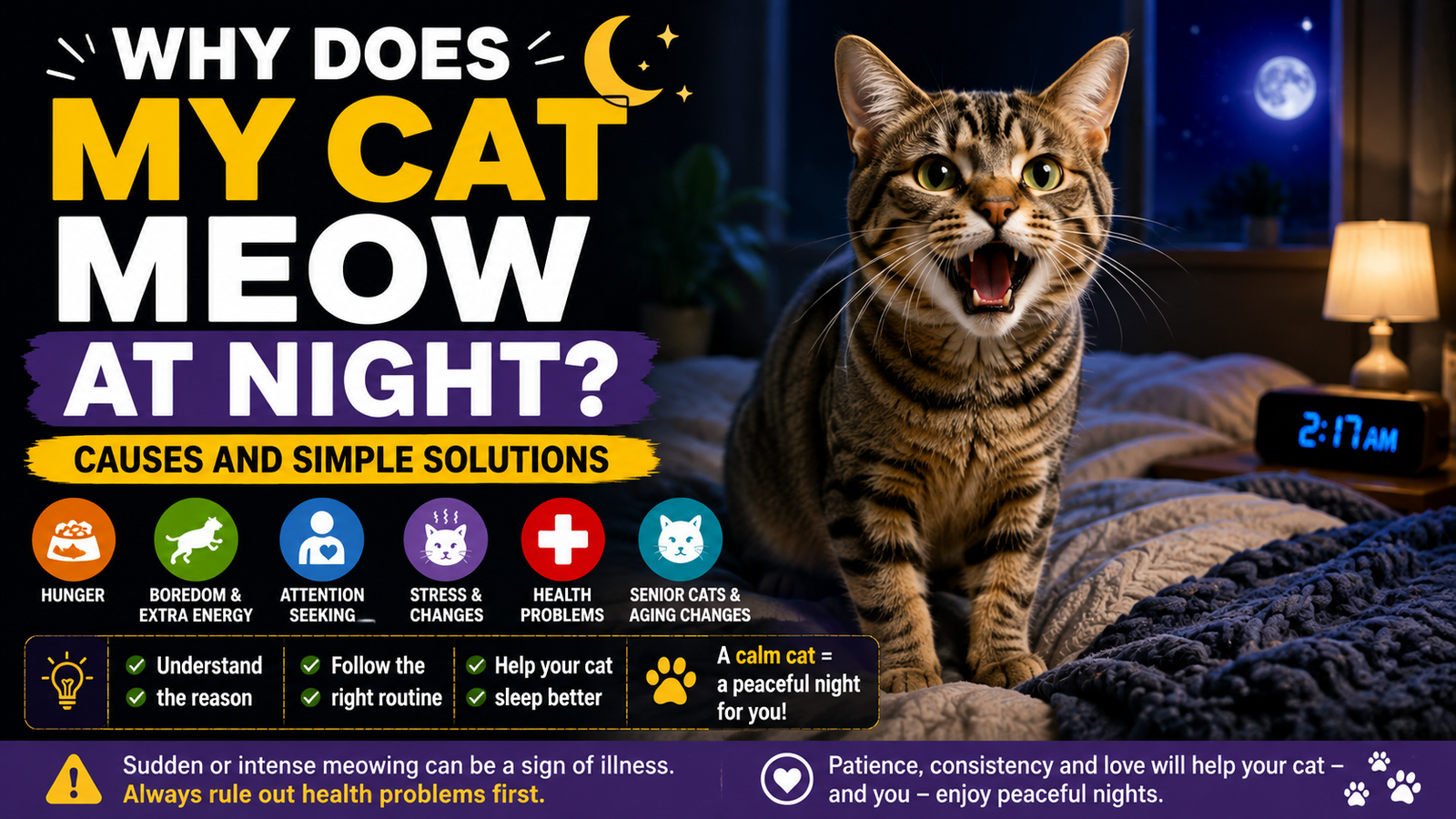

Nighttime meowing is common in many cats.
Your cat may walk around the house. Sit outside your bedroom. Meow near the food bowl. Or wake you several times during the night.
Sometimes the reason is simple.
Your cat may be hungry. Bored. Lonely. Or full of energy.
In other cases nighttime vocalizing may be connected with stress. Pain. Hearing changes. Thyroid disease. Cognitive changes. Or another health problem.
The best solution depends on why the behavior is happening.
This guide explains the most common causes. How to build a better evening routine. Which mistakes can make nighttime meowing worse. And when your cat needs veterinary care.
Quick Answer
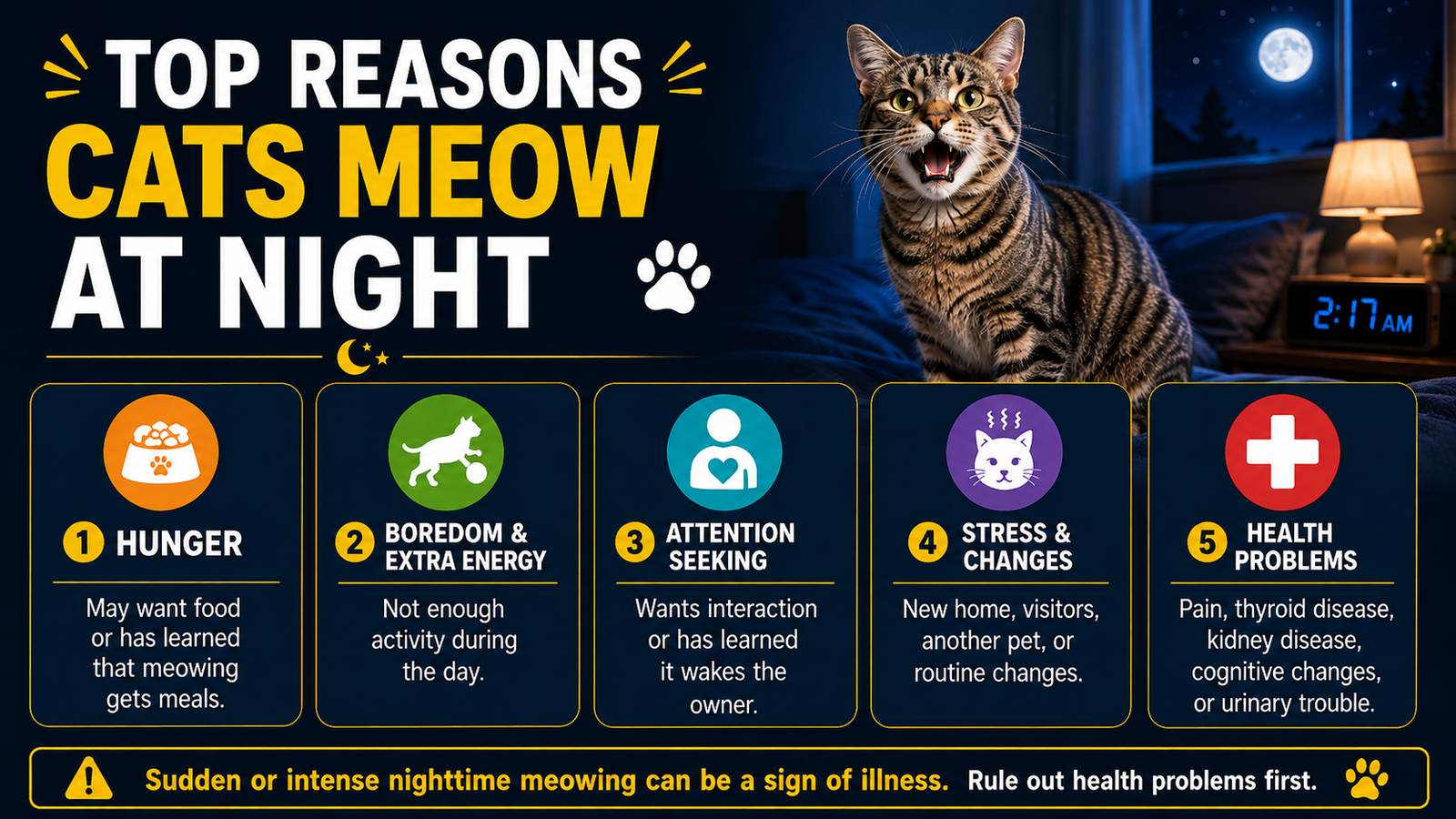
A cat may meow at night because of hunger. Boredom. Extra energy. Attention seeking. Stress. A new routine. Or a medical problem.
Start with active evening play. A measured meal. A clean litter box. Fresh water. And a calm sleeping area. Do not reward repeated attention seeking with food every time. Contact a veterinarian when nighttime meowing starts suddenly. Becomes intense. Or happens with weight loss. Excessive thirst. Pain. Confusion. Vomiting. Or urinary changes.
Why Are Cats Active at Night?
Cats are naturally more active around dawn and dusk.
This does not mean every cat should stay awake all night.
However an indoor cat may sleep for many hours during the day and have plenty of energy left at bedtime.
Nighttime activity may include:
- Running
- Playing
- Climbing
- Scratching
- Looking out windows
- Searching for food
- Calling for people
A better daytime and evening routine can reduce some nighttime activity.
Common Reasons Cats Meow at Night
| Possible Cause | What You May Notice | What May Help |
|---|---|---|
| Hunger | Meowing near the kitchen or food bowl | Measured evening meal or timed feeder |
| Boredom | Running. Scratching. Calling. Waking people | More daytime enrichment and evening play |
| Attention seeking | Meowing outside your bedroom | Reward calm behavior during the day |
| Stress | Hiding. Pacing. Restlessness. Increased vocalizing | Quiet spaces and predictable routine |
| Medical problem | Sudden meowing with health or behavior changes | Veterinary examination |
1. Your Cat May Be Hungry
Some cats learn that nighttime meowing leads to food.
If you wake up and feed your cat every time it cries the behavior can become stronger.
Your cat may begin to think:
Meowing wakes my person. My person gives me food.
This can turn into a daily habit.
What You Can Do
- Use measured meals
- Feed a balanced evening meal
- Do not add extra calories every night
- Try a timed feeder when early morning hunger is a problem
- Keep the schedule consistent
Read our complete guide on how often to feed a cat.
2. Your Cat May Have Too Much Energy
An indoor cat may sleep for much of the day.
If there is little activity before bedtime the cat may be ready to play while you are ready to sleep.
A useful evening routine can include:
- Active play
- A small calm break
- A measured meal
- Grooming or quiet attention
- Lights lower
- Bedtime
This gives the evening a predictable pattern.
3. Your Cat May Be Bored
Bored cats may create their own activities.
This can include:
- Meowing
- Running through the house
- Scratching furniture
- Knocking objects down
- Waking people
- Chasing feet
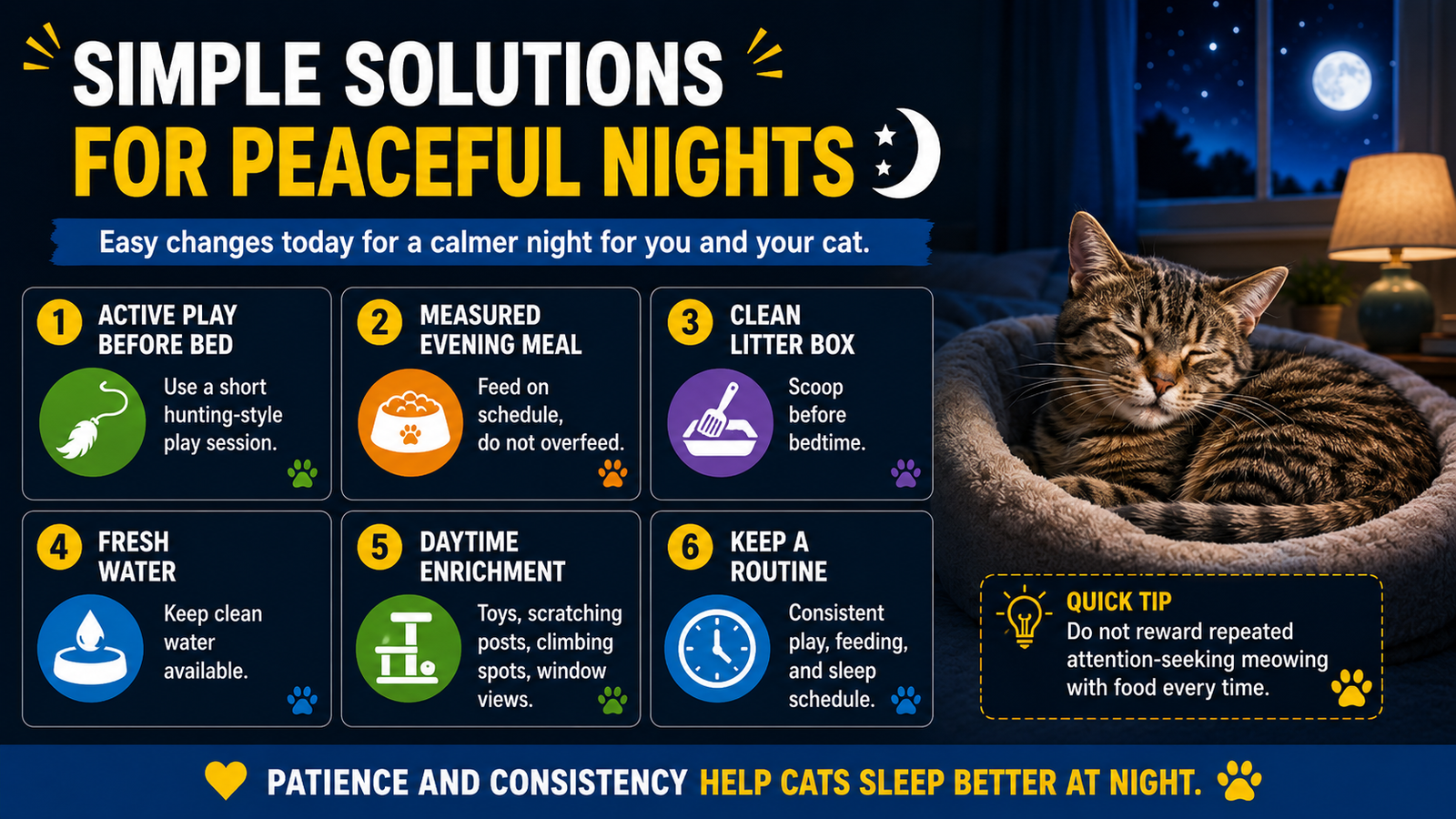
Daily enrichment can reduce boredom.
Read our guide on how to keep an indoor cat happy and mentally stimulated.
4. Your Cat May Want Attention
Your cat may want:
- Petting
- Play
- Food
- Access to a room
- Company
If attention is given every time your cat meows then the behavior may continue.
This does not mean you should ignore all vocalizing.
First make sure your cat is safe. Has food according to its schedule. Has fresh water. Has access to a clean litter box. And does not appear sick.
Then reward quiet behavior rather than repeated meowing.
5. The Litter Box May Be Dirty
Some cats become restless when their litter box is dirty.
Before bedtime:
- Scoop urine clumps
- Remove stool
- Check litter depth
- Make sure the box is easy to reach
Read our complete guide on how often to clean a cat litter box.
6. Your Cat May Be Thirsty
Fresh water should remain available day and night.
Some cats prefer:
- Wide bowls
- Several water locations
- Moving water
- Water away from the litter box
- Clean ceramic or stainless steel bowls
Read how much water a cat should drink each day.
7. A New Environment May Cause Stress
A new cat may meow at night because the home feels unfamiliar.
New smells. New sounds. New people. And new rooms can all increase stress.
Start with a quiet safe room.
Include:
- A litter box
- Food
- Water
- A covered hiding place
- A scratching surface
- A comfortable bed
Read our guide on how to introduce a new cat to your home.
8. Another Pet May Be Disturbing Your Cat
Night may make social conflict easier to notice.
One cat may block another cat from:
- Food
- Water
- Litter boxes
- Doorways
- Sleeping areas
You may not see an obvious fight.
Watch for staring. Chasing. Blocking. And one cat leaving when another approaches.
Provide several resources in different parts of the home.
9. Outdoor Cats May Trigger Vocalizing
Your indoor cat may see or smell another cat outside.
This can lead to:
- Meowing
- Growling
- Window watching
- Urine marking
- Restless pacing
Close curtains at night when outdoor animals cause stress.
Move your cat’s bed away from the window if needed.
10. Your Cat May Be in Heat
An unspayed female cat may become very vocal during heat.
You may also notice:
- Rolling
- Restlessness
- Extra affection
- Trying to escape
- Holding the tail to one side
Keep the cat safely indoors.
Discuss spaying with your veterinarian.
11. Senior Cats May Meow More at Night
Older cats may vocalize because of:
- Reduced hearing
- Reduced vision
- Arthritis
- Thyroid disease
- Kidney disease
- High blood pressure
- Cognitive changes
A senior cat that suddenly becomes noisy at night should not simply be treated as a behavior problem.
Schedule a veterinary examination.
12. Cognitive Changes Can Affect Older Cats
Some senior cats become confused.
You may notice:
- Walking around at night
- Staring at walls
- Getting stuck in corners
- Sleeping more during the day
- Waking frequently at night
- Missing the litter box
- Calling for no obvious reason
These changes need veterinary evaluation.
Other illnesses can cause similar signs.
13. Hyperthyroidism Can Increase Vocalizing
Hyperthyroidism is more common in older cats.
Possible signs include:
- Weight loss
- Increased hunger
- Restlessness
- More drinking
- More urination
- Vomiting
- Increased vocalizing
A veterinarian can perform blood tests when thyroid disease is suspected.
14. Pain May Cause Nighttime Meowing
A painful cat may become more vocal when the home becomes quiet.
Possible signs include:
- Reduced jumping
- Limping
- Hiding
- Hunched posture
- Growling when touched
- Reduced grooming
- Difficulty using stairs
Do not give human pain medicine.
Human Pain Medicine Can Be Dangerous
Products such as acetaminophen and ibuprofen can be extremely dangerous for cats. Use only medication prescribed by a veterinarian.
How to Reduce Nighttime Meowing
Step 1: Rule Out a Health Problem
Sudden behavior change should be taken seriously.
Look at:
- Appetite
- Weight
- Water intake
- Urination
- Stool
- Movement
- Breathing
- Grooming
Step 2: Increase Daytime Activity
Use short play sessions during the day.
Try:
- Wand toys
- Soft balls
- Food puzzles
- Safe climbing
- Window watching
Step 3: Use Active Evening Play
Play before the final meal.
Allow your cat to stalk. Chase. And catch the toy.
End with a successful catch.
Step 4: Give the Evening Meal
Provide a measured portion according to the daily feeding plan.
Do not use an extra meal on top of the normal daily calories.
Step 5: Clean the Litter Box
Scoop before bedtime.
Step 6: Refresh the Water
Make sure clean water is easy to reach.
Step 7: Create a Calm Sleep Area
Provide:
- A comfortable bed
- A quiet location
- A safe hiding place
- A familiar blanket
Step 8: Keep the Routine Consistent
Try to use similar play. Feeding. And bedtime times every day.
A Simple Evening Routine
60 to 90 minutes before bed
Short active play session.
30 minutes before bed
Measured evening meal.
15 minutes before bed
Scoop the litter box. Refresh water. Reduce household activity.
Bedtime
Quiet environment. Comfortable sleeping area. No unnecessary food rewards for attention seeking.
Can a Timed Feeder Help?
Yes.
A timed feeder may be useful when your cat wakes you early for food.
The feeder can provide a measured amount at the same time each morning.
This may help break the connection between waking you and receiving food.
Count the timed meal as part of the normal daily calories.
Should You Ignore a Cat Meowing at Night?
Do not automatically ignore every meow.
First make sure:
- Your cat is healthy
- Water is available
- The litter box is accessible
- Your cat is not trapped
- There is no sign of pain
- There is no urinary emergency
Once health and basic needs are covered you can avoid rewarding attention seeking vocalizing.
What You Should Not Do
Do Not Shout
Shouting may increase fear and stress.
Do Not Spray Water
This does not teach your cat what to do instead.
Do Not Hit or Physically Punish
Physical punishment can damage trust and create defensive behavior.
Do Not Feed Every Time the Cat Meows
This can teach your cat to meow more.
Do Not Lock a Cat Away Without Resources
A separate sleeping area needs water. A litter box. Comfortable bedding. And enough space.
Could Your Cat Simply Be Talking?
Some cats naturally vocalize more than others.
Individual personality matters.
Some breeds are also known for being more vocal.
A talkative cat that has always behaved this way and remains healthy may simply enjoy communicating.
A sudden major increase is different and deserves attention.
When Nighttime Meowing Is an Emergency
Seek urgent veterinary help when nighttime vocalizing happens with:
- Straining to urinate
- Producing little or no urine
- Open mouth breathing
- Collapse
- Severe weakness
- Repeated vomiting
- Major injury
- Severe pain
- Sudden inability to walk
Urinary Blockage Needs Urgent Care
A cat that repeatedly visits the litter box. Cries. Strains. And produces little or no urine may have a urinary blockage. This can become life threatening and needs urgent veterinary care.
When Should You Contact a Veterinarian?
Arrange veterinary care when your cat:
- Suddenly starts meowing at night
- Becomes much louder than normal
- Loses weight
- Drinks much more
- Urinates more often
- Stops eating
- Vomits repeatedly
- Has diarrhea
- Seems confused
- Stops jumping
- Appears painful
- Is an older cat with new nighttime behavior
Frequently Asked Questions
Why does my cat walk around meowing at night?
Your cat may be bored. Hungry. Looking for attention. Stressed. Or experiencing a medical problem.
Why does my cat meow outside my bedroom?
Your cat may want access. Attention. Food. Or company.
Should I feed my cat when it wakes me?
Only feed according to the normal schedule. Repeated nighttime feeding may teach the cat to wake you for food.
Can playing before bed help?
Yes. Active evening play may reduce extra energy before bedtime.
Why does my senior cat meow at night?
Senior cats may vocalize because of pain. Hearing changes. Thyroid disease. Kidney disease. High blood pressure. Or cognitive changes.
Can stress cause nighttime meowing?
Yes. A new pet. Visitors. Outdoor cats. Moving house. Or changes in routine may increase vocalizing.
Can a dirty litter box make a cat meow?
Yes. Some cats become restless when the litter box is dirty or difficult to access.
Can I close my bedroom door?
Yes when your cat has safe access to food according to its schedule. Fresh water. A clean litter box. Comfortable sleeping areas. And no medical problem.
Will getting another cat stop nighttime meowing?
Not necessarily. Some cats prefer living alone. Adding another cat can create more stress when introductions are not handled carefully.
Final Thoughts
Nighttime meowing has many possible causes.
Start by checking your cat’s health and basic needs.
Provide daily enrichment.
Use active evening play.
Feed measured meals on a regular schedule.
Clean the litter box before bed.
Keep fresh water available.
Create a quiet sleeping area.
Do not punish your cat for vocalizing.
Sudden or intense nighttime meowing can be a sign of illness. Especially in an older cat.
When the behavior changes without a clear reason a veterinary examination is the safest next step.
Related DailyPetTips Guides
- How Often Should You Feed a Cat?
- How to Keep an Indoor Cat Happy and Mentally Stimulated
- Why Is My Cat Hiding?
- How Much Water Should a Cat Drink Each Day?
- How Often Should You Clean a Cat Litter Box?
- Explore All Cat Guides
- Explore Pet Health Guides



Pet parent notes