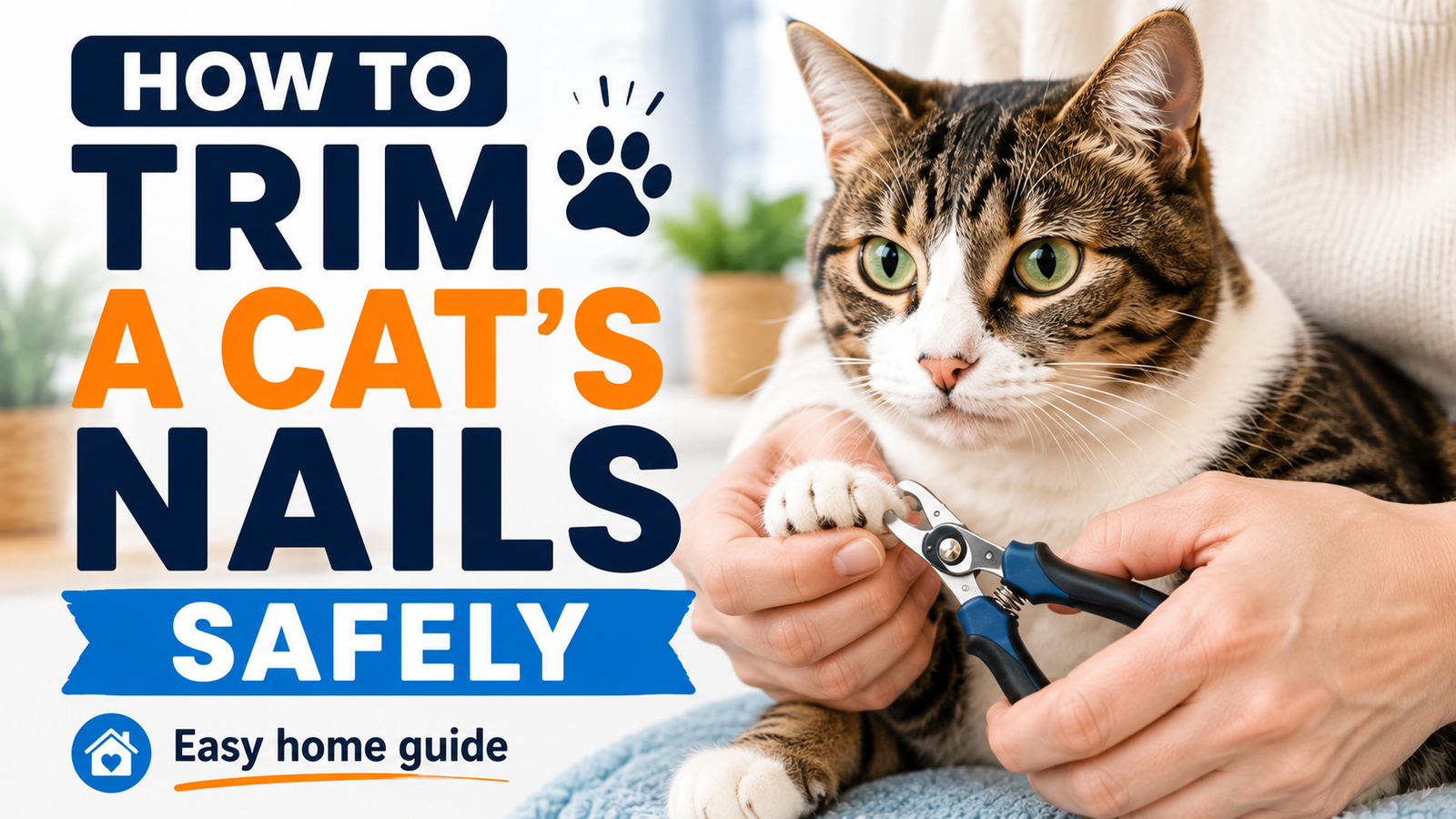

Regular nail trimming can help keep your cat comfortable and reduce accidental scratches.
It can also make it less likely that a nail becomes extremely long and catches on blankets. Carpet. Furniture. Or skin.
Cat nails contain a sensitive area called the quick.
The quick contains blood vessels and nerves. Cutting into it can cause pain and bleeding.
This is why cat nail trimming should be slow. Calm. And careful.
This guide explains how often to check the nails. What tools to use. How to find the quick. How to trim each nail. How to help a nervous cat. And when professional grooming or veterinary care is safer.
Quick Answer
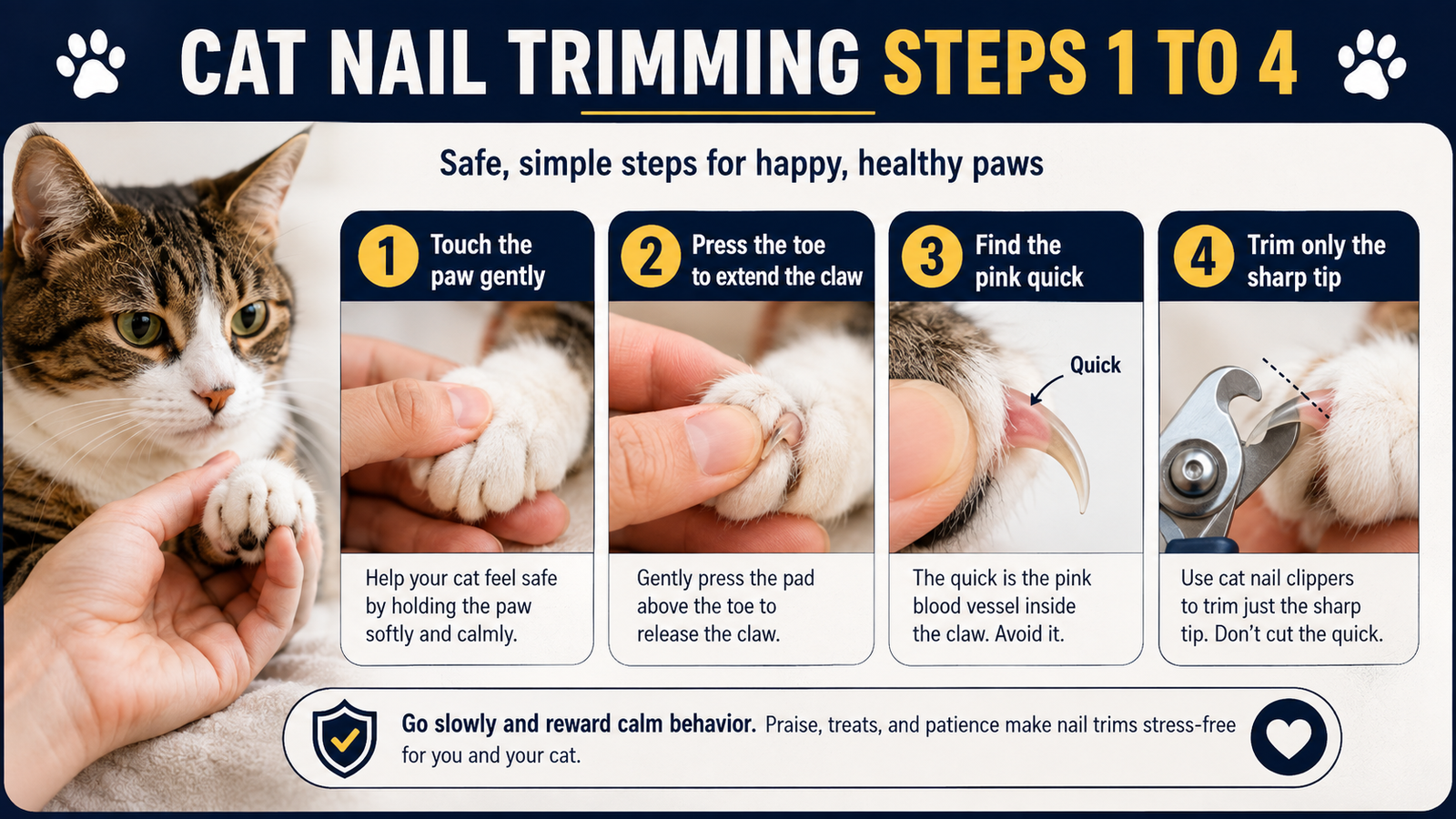
Use cat nail clippers and trim only the sharp transparent tip of each nail.
Press the toe gently so the nail extends. Find the pink quick inside the nail. Cut several millimeters in front of it. Trim one or two nails at first if your cat becomes nervous. Never force a long session.
Why Do Cats Need Nail Trimming?
Cats naturally maintain their claws through scratching.
However scratching does not always keep every nail at a safe length.
Regular nail checks may help you notice:
- Very sharp tips
- Overgrown nails
- Broken claws
- Split nails
- Swelling around a toe
- A nail growing toward the paw pad
- Pain when walking
Older cats may need more help because they may scratch less or move less.
Indoor cats may also wear their claws differently from very active outdoor cats.
How Often Should You Trim a Cat’s Nails?
There is no single schedule for every cat.
Check the nails every one to two weeks.
Some cats may need the sharp tips trimmed every two to four weeks.
Others may need less frequent trimming.
The correct schedule depends on:
- Age
- Activity level
- How often the cat scratches
- Whether the cat lives indoors
- Nail growth speed
- Health and mobility
| Cat | Check Nails | Important Note |
|---|---|---|
| Healthy adult cat | Every 1 to 2 weeks | Trim when the tips become long and sharp. |
| Kitten | Check weekly | Use very short practice sessions. |
| Senior cat | Check weekly | Older cats may develop overgrown claws more easily. |
| Cat with paw pain | Follow veterinary advice | Do not force trimming on a painful paw. |
What Tools Do You Need?
Prepare everything before your cat arrives.
- Cat nail clippers
- Small treats
- A towel
- Good lighting
- Styptic powder or cornstarch for minor bleeding
- A quiet room
Use clippers designed for small animals.
Blunt or damaged clippers may crush the nail instead of making a clean cut.
What Does the Quick Look Like?
The quick is the pink area inside a light colored nail.
It contains nerves and blood vessels.
Do not cut into it.
Leave a safe space between the cut and the quick.
What About Dark Nails?
The quick can be difficult to see in dark nails.
Trim only a tiny amount from the tip.
Look at the cut surface after every small trim.
Stop when the center begins looking darker or softer.
If you are unsure ask a veterinarian or groomer to show you the correct technique.
How to Prepare Your Cat for Nail Trimming
Do not begin by holding your cat tightly and trimming every nail.
Build comfort first.
Practice 1: Touch the Paw
Touch one paw gently.
Give a treat.
Practice 2: Hold the Paw
Hold the paw for one second.
Release it and reward your cat.
Practice 3: Press One Toe
Press gently above and below one toe so the claw extends.
Release immediately.
Practice 4: Show the Clippers
Let your cat see and smell the clippers.
Give another treat.
Practice 5: Trim One Nail
Trim only one sharp tip.
End the session after a success.
How to Trim a Cat’s Nails Step by Step
Step 1: Choose a Calm Time
Trim when your cat is relaxed.
After a meal or quiet play may work well.
Step 2: Position Your Cat Comfortably
Your cat may sit beside you or on your lap.
Do not place the cat on a slippery surface.
Step 3: Hold One Paw
Support the paw gently.
Do not squeeze.
Step 4: Extend One Nail
Press gently on the toe pad and top of the toe.
The nail should extend.
Step 5: Find the Quick
Look for the pink area inside a clear nail.
Plan the cut well in front of it.
Step 6: Trim Only the Sharp Tip
Cut the narrow pointed end.
Do not try to make the nail extremely short.
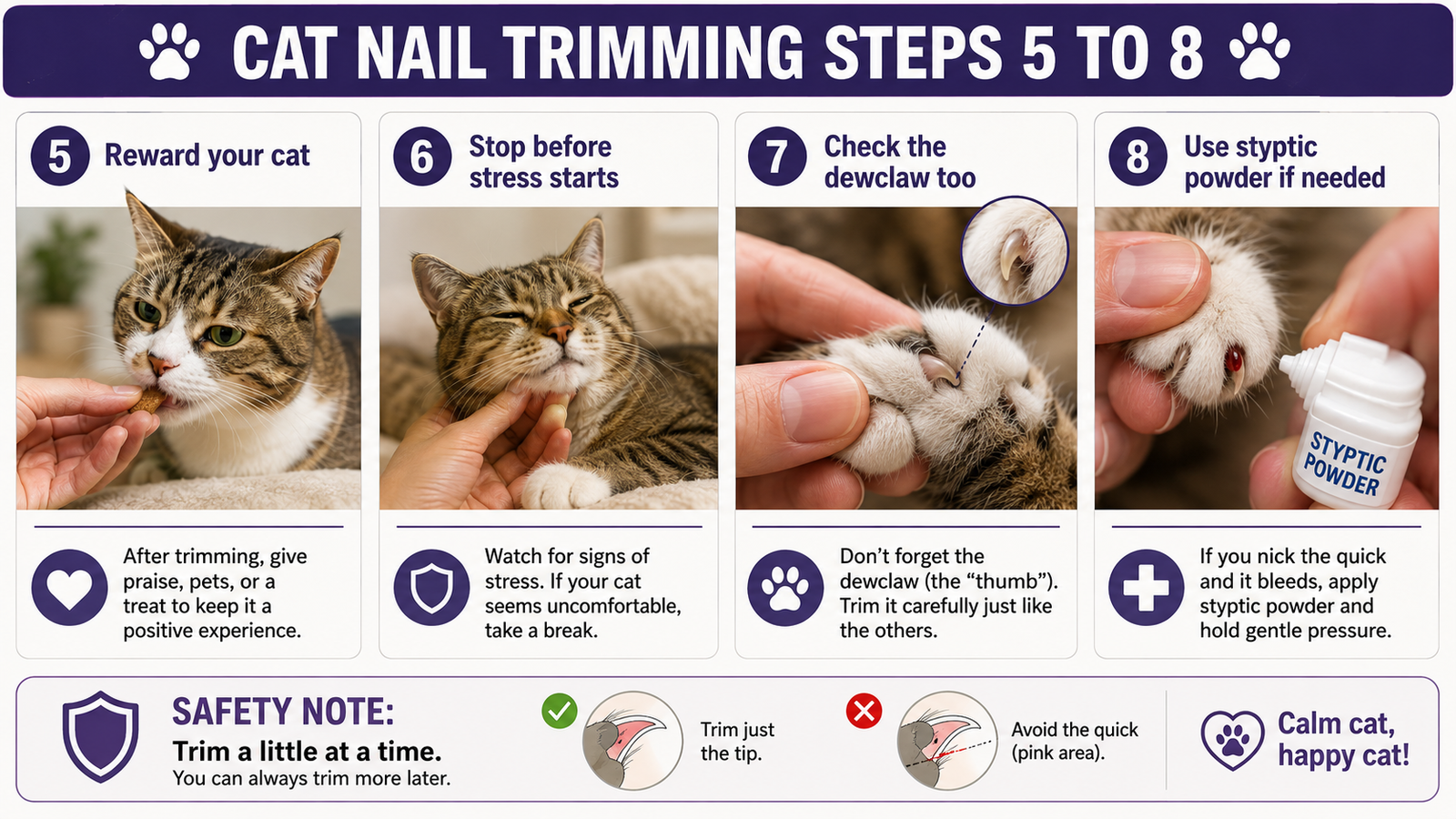
Step 7: Reward Your Cat
Give a small treat after one or several nails.
Step 8: Stop Before Your Cat Becomes Upset
You do not need to finish every paw in one session.
One paw today and another tomorrow is completely acceptable.
How Much Nail Should You Cut?
Less is safer.
Remove only the sharp hooked tip.
Leave clear space before the quick.
Never cut simply because the nail still looks long.
The quick may also extend farther into an overgrown nail.
What If You Cut the Quick?
Stay calm.
A small accidental cut can bleed more than expected.
Apply styptic powder to the nail.
If you do not have styptic powder you may use a small amount of cornstarch for minor bleeding.
Apply gentle pressure.
Keep your cat indoors and calm.
Contact a Veterinarian for Ongoing Bleeding
Seek veterinary help when bleeding does not stop. The nail is badly torn. Your cat shows strong pain. Or the toe becomes swollen.
How to Trim the Front Paws
Front claws may become sharp more quickly because cats use them heavily for scratching and climbing.
Check every toe.
Do not forget the dewclaw.
The dewclaw sits higher on the inner side of the front leg.
It may not touch the floor and can become overgrown.
How to Trim the Back Paws
Back nails may need less frequent trimming in some cats.
Use the same careful method.
Extend one nail at a time.
Trim only the pointed end.
What If Your Cat Hates Nail Trimming?
Make the task smaller.
Try this routine:
- Touch one paw.
- Give a treat.
- Press one toe.
- Give another treat.
- Trim one nail.
- End the session.
Repeat later.
The goal is progress without a fight.
Should You Wrap a Cat in a Towel?
A towel may help some calm cats feel secure.
Do not tightly restrain a frightened cat.
Wrap the body loosely while leaving one paw available.
Stop if your cat struggles strongly. Pants. Screams. Or becomes aggressive.
Signs Your Cat Needs a Break
Stop when you notice:
- Tail whipping
- Ears flat against the head
- Growling
- Hissing
- Trying to bite
- Strong pulling away
- Rapid breathing
- Repeated attempts to escape
These signals mean the session has become too difficult.
Can Scratching Posts Replace Nail Trimming?
Scratching posts help cats maintain their claws naturally.
They do not always replace trimming.
Provide vertical and horizontal scratching surfaces.
Read our guide on how to stop a cat from scratching furniture.
How Grooming Helps With Paw Checks
Regular grooming is a good time to inspect the paws.
Check for:
- Redness
- Swelling
- Broken nails
- Hair wrapped around toes
- Something stuck between the toes
Read our guide on how to brush a cat safely at home.
Do Older Cats Need More Nail Care?
Often yes.
Older cats may scratch less because of reduced activity or arthritis.
The claws may become thicker and longer.
Check them regularly.
A nail that curves toward the paw pad needs attention.
Can an Overgrown Nail Grow Into the Paw Pad?
Yes.
A very long curved nail may press into or enter the paw pad.
Do not pull it out at home when it is embedded.
Contact a veterinarian.
The paw may need cleaning. Pain relief. And treatment for infection.
Common Cat Nail Trimming Mistakes
Cutting Too Much
Trim only the tip.
Using Dull Clippers
Dull tools may crush or split the nail.
Forcing Every Nail in One Session
Several short sessions are often better.
Ignoring the Dewclaw
Check the inner front claw carefully.
Holding the Cat Too Tightly
Excessive restraint can increase fear.
Punishing Struggling
Do not shout or hit.
Trimming a Painful Paw
Contact a veterinarian when the paw is swollen or painful.
When Should You Use a Professional Groomer?
A professional cat groomer may help when:
- Your cat strongly resists trimming
- You cannot see the quick clearly
- The claws are very thick
- You are nervous about cutting
- Your cat has several overgrown claws
Choose someone experienced with cats.
When Should You Contact a Veterinarian?
Contact a veterinarian when:
- A nail is embedded in the paw pad
- The paw is swollen
- The nail is badly broken
- Bleeding does not stop
- Your cat limps
- Pus or a bad smell appears
- Your cat cries when the paw is touched
- The toe looks infected
Frequently Asked Questions
Can I use human nail clippers?
Small human clippers may work in some situations. Cat nail clippers usually give better control.
Do indoor cats need nail trimming?
Many indoor cats benefit from regular nail checks and occasional trimming.
How often should I check the nails?
Check them about every one to two weeks.
Why are my cat’s nails always sharp?
Sharp claws are normal. Scratching removes old claw layers and exposes newer pointed claws.
Should I trim every nail?
Check every nail including the dewclaws. Only trim nails that need it.
Can I cut a dark cat nail?
Yes. Remove very small amounts because the quick is difficult to see.
Do nail caps replace trimming?
No. Nails still grow under caps and require monitoring.
Can nail trimming stop furniture scratching?
It may reduce damage but it does not remove the natural need to scratch.
Final Thoughts
Cat nail trimming should be calm and simple.
Use sharp cat nail clippers.
Extend one nail at a time.
Find the quick.
Trim only the sharp transparent tip.
Use treats and short sessions.
Never force your cat through a long stressful grooming session.
Ask a groomer or veterinarian for help when you are unsure or the paw appears painful.
Related DailyPetTips Guides
- How to Brush a Cat at Home Safely
- How to Stop a Cat From Scratching Furniture
- How to Keep an Indoor Cat Happy and Mentally Stimulated
- Explore All Cat Guides
- Explore Pet Grooming Guides



Pet parent notes