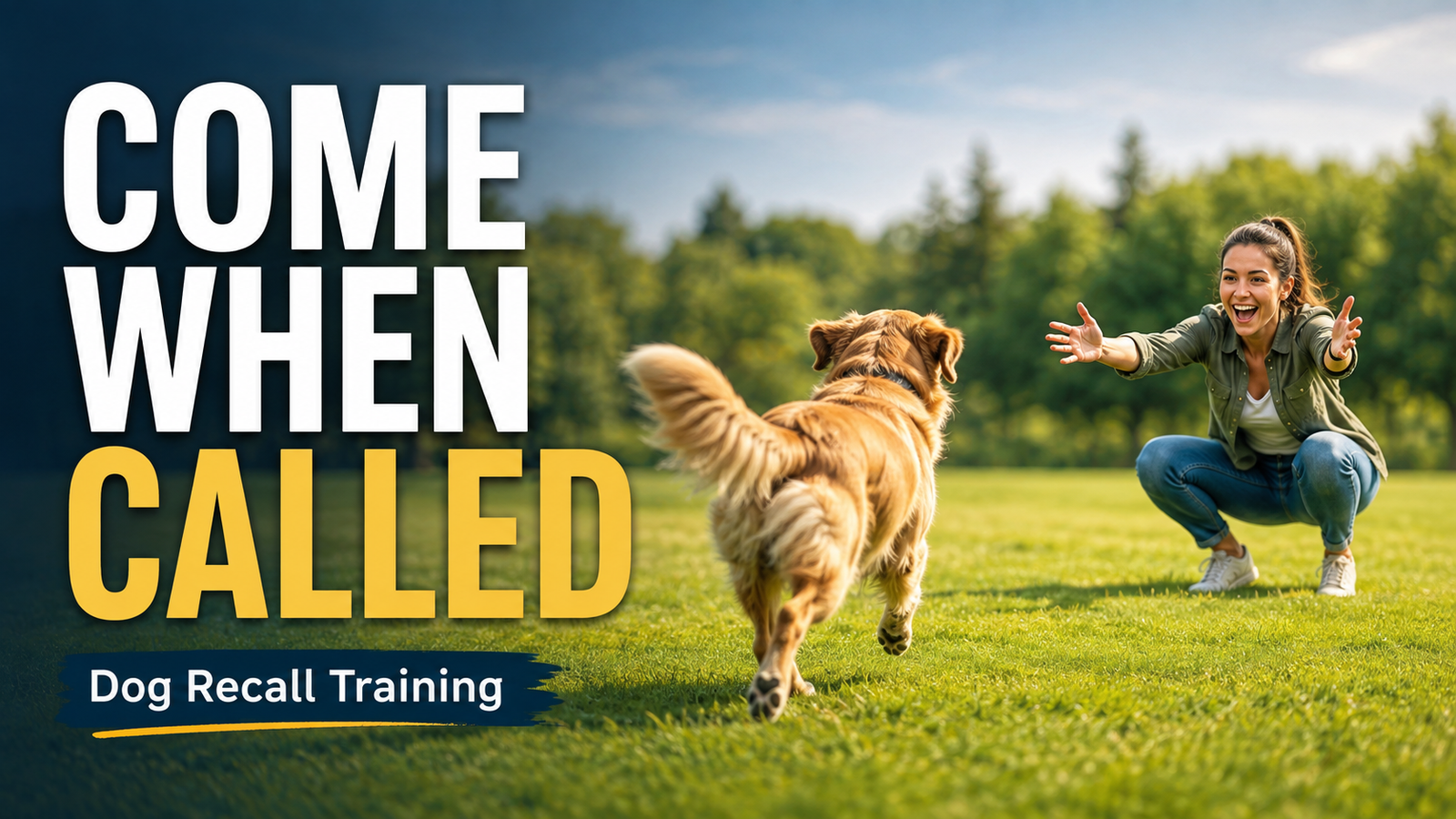
Teaching your dog to come when called is one of the most useful training skills.
A strong recall can help you move your dog away from danger. It can make outdoor activities easier. It can also improve communication between you and your dog.
Recall training takes time. A dog may come perfectly inside the home but ignore the same cue in a park.
This does not mean the dog is stubborn. Outdoor areas have more smells. People. Animals. Sounds. And movement.
This guide explains how to choose a recall word. How to begin indoors. How to practice safely outside. How to use a long line. What mistakes to avoid. And when professional help may be needed.
Quick Answer
Say your dog’s recall word one time. Move backward. Use a happy voice. Reward your dog as soon as it reaches you.
Begin inside the home. Practice from a short distance. Use very good treats. Move to outdoor training only after your dog responds well indoors. Use a long line in open areas. Never allow your dog to practice ignoring the recall cue near roads or other dangers.
Why Is Recall Training Important?
A reliable recall gives you a way to ask your dog to return.
This can be useful when:
- Your dog moves toward a road
- A gate opens unexpectedly
- Your dog approaches another animal
- Your dog moves toward unsafe food
- Your dog runs too far in an open area
- You need to attach the leash
- Your dog becomes distracted
- You need to end outdoor play
Recall training does not make every place safe for off leash activity.
Roads. Wildlife areas. Crowded parks. Farms. And places with leash laws may still require a leash.
What Does a Reliable Recall Look Like?
A reliable recall means your dog:
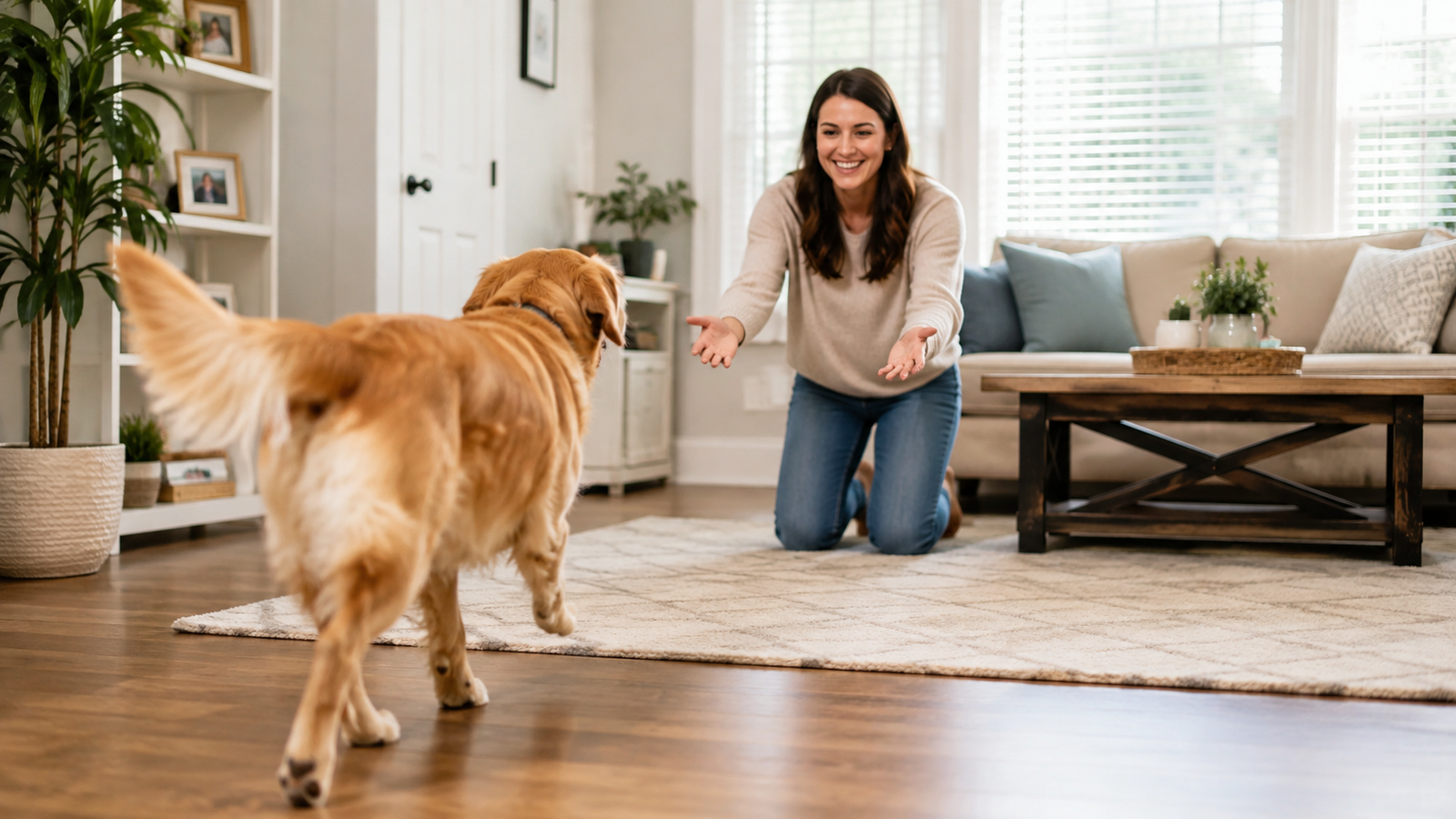
- Notices the cue
- Turns toward you
- Moves directly toward you
- Reaches you without stopping
- Allows you to touch the collar or harness
- Waits calmly for the next instruction
A dog does not need to run at full speed every time.
The important point is that the dog returns safely and stays close enough for you to take control.
What You Need Before Training
Prepare:
- Small high value treats
- A quiet room
- A standard leash
- A long training line
- A well fitted harness
- A treat pouch
- A calm training plan
Use treats your dog really likes.
Normal food may work indoors. Outdoor training may need chicken. Cheese. Or another special reward that is safe for your dog.
Cut rewards into small pieces.
How to Choose a Recall Word
Choose one short word.
Common recall words include:
- Come
- Here
- To me
Every family member should use the same word.
Do not use the recall word for situations your dog dislikes whenever possible.
For example do not call your dog only when:
- Play is ending
- A bath is starting
- Nails will be trimmed
- The dog will be left alone
- The dog is going inside
The recall word should predict good things.
Should You Use the Dog’s Name as the Recall Cue?
Your dog’s name should get attention.
The recall word should tell your dog to move toward you.
A useful pattern is:
Dog’s name. Then recall word.
Example:
Max. Come.
Avoid repeating the name many times.
How to Teach a Dog to Come When Called
Step 1: Begin Very Close
Sit or stand a short distance from your dog.
Say the recall word one time.
Use a happy and welcoming voice.
Move backward one or two steps.
Movement can encourage your dog to follow.
Step 2: Reward Immediately
Give the reward as soon as your dog reaches you.
Do not wait until the dog becomes distracted again.
Use calm praise and a small treat.
Step 3: Touch the Collar
Gently touch or hold the collar before giving the reward.
This teaches your dog that reaching you includes allowing safe handling.
Without this step some dogs learn to come close and then run away before the leash can be attached.
Step 4: Release Your Dog Again
After the reward use a release word such as Okay or Free.
Allow your dog to return to a safe activity.
This helps prevent the recall cue from always ending the fun.
Step 5: Increase the Distance
Move a little farther away.
Call once.
Reward when your dog arrives.
Increase distance slowly.
Step 6: Practice in Different Rooms
Practice in:
- The living room
- The kitchen
- A hallway
- The garden
- Another quiet indoor area
Dogs need practice in different places.
Step 7: Add Easy Distractions
Place a toy on the floor.
Allow your dog to notice it.
Call your dog from a short distance.
Use a better reward than normal.
If your dog ignores you then reduce the distance or remove the distraction.
Step 8: Practice With Another Person
Ask another person to stand several steps away.
Take turns calling the dog.
Reward every correct response.
This game can make recall training enjoyable.
Step 9: Move Outdoors on a Leash
Begin in a quiet garden or enclosed area.
Keep your dog on a leash or long line.
Call from a short distance.
Reward more generously than you did indoors.
Step 10: Increase Outdoor Difficulty Slowly
Add one new challenge at a time.
This may include:
- A new smell
- A person far away
- A calm dog at a distance
- A moving bicycle far away
- A quiet park
- A longer distance
Do not add distance and strong distractions at the same time.
How Long Should Recall Sessions Be?
Begin with three to five minutes.
A puppy may only manage one or two minutes.
Practice several short sessions during the day.
Stop after a successful response.
Do not continue until your dog becomes bored.
How Often Should You Practice?
Practice a few recalls every day.
You can use normal daily moments.
Call your dog:
- Before giving food
- Before opening the garden door
- From another room
- Before play
- Before attaching the leash
- During a safe walk on a long line
Do not call your dog constantly.
The cue should remain clear and meaningful.
How to Use a Long Line Safely
A long line gives your dog more freedom while you keep physical control.
Attach the long line to a well fitted harness.
A sudden stop on a collar may place pressure on the neck.
Use the long line in:
- A quiet field
- A large garden
- An open training area
- A calm park away from roads
Do not use a long line near:
- Traffic
- Bicycles
- Fast moving dogs
- Playground equipment
- Thick trees or bushes
- Steep ground
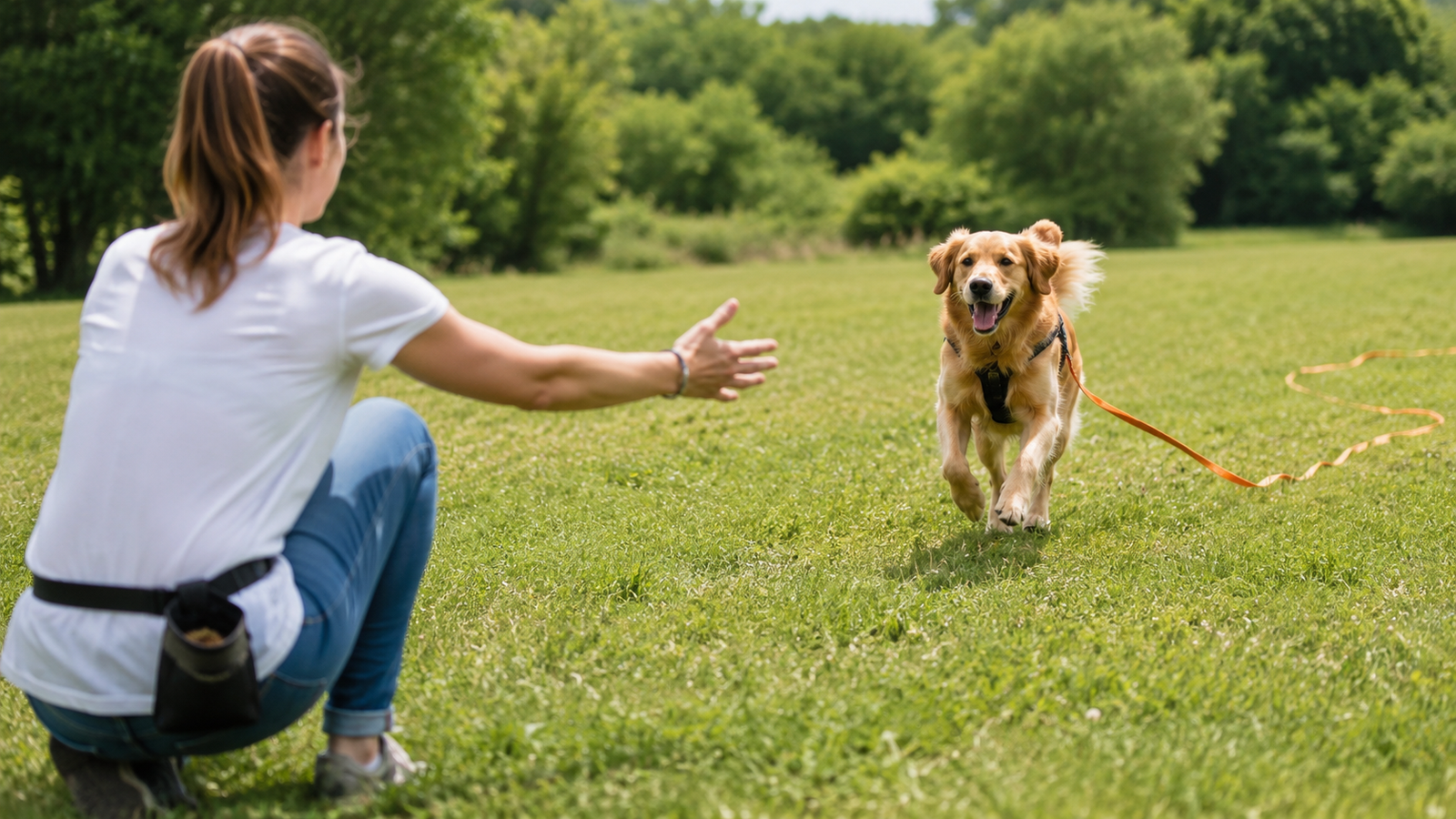
Wear gloves if the line may move quickly.
Do not wrap the line around your hand.
A Long Line Is Not a Retractable Leash
A training line is a long flat leash. It should be handled carefully and attached to a harness. It gives your dog freedom while keeping the dog safely connected to you.
How to Practice Recall Outdoors
Allow your dog to explore on the long line.
Wait until your dog is only mildly distracted.
Say the recall word once.
Move backward.
Reward your dog when it reaches you.
Then release your dog to explore again.
This teaches your dog that coming back does not always end the walk.
What Should You Do if Your Dog Ignores the Cue?
Do not repeat the cue many times.
Avoid saying:
Come. Come. Come. Come.
Instead:
- Move closer to your dog.
- Use a happy sound.
- Move backward.
- Show a better reward.
- Reduce the distraction.
- Practice from a shorter distance.
Your dog is showing that the exercise is too difficult.
Make the next attempt easier.
What Should You Do if Your Dog Comes Slowly?
Use more exciting rewards.
Move backward quickly.
Clap gently or make a happy sound.
Reward your dog even when the response is slow.
Do not punish a slow recall.
Punishment may make the next recall even slower.
Why You Should Never Punish a Dog for Coming Back
Your dog may take longer than expected.
You may feel frustrated.
Still reward the dog when it arrives.
If you shout or punish the dog after it comes then the dog may learn that returning to you is unsafe.
The American Veterinary Society of Animal Behavior supports reward based training methods.
Never Chase Your Dog
Chasing may turn the situation into a game. Move away from your dog instead. Use a happy voice. Lower your body. And reward the dog for following you.
How to Build an Emergency Recall
An emergency recall is a special cue used only for urgent situations.
Choose a word that you do not normally use.
Examples may include:
- Quick
- Now
- Emergency
Use a very special reward.
This could be several small treats given one after another.
How to Train the Emergency Cue
- Begin inside the home.
- Say the special word.
- Give several high value treats.
- Do not ask for another behavior.
- Repeat only a few times each week.
After your dog learns that the word predicts an excellent reward begin calling from a short distance.
Do not use the emergency cue for normal daily recalls.
How to Teach Recall Around Other Dogs
Begin far away from other dogs.
Your dog should still be able to eat treats and respond to you.
Reward your dog for looking at another dog and then looking back at you.
Call from a short distance while using a leash or long line.
Move farther away when your dog:
- Stares constantly
- Pulls strongly
- Barks
- Lunges
- Cannot eat
- Cannot hear the cue
Do not practice recall by allowing your dog to run freely toward unknown dogs.
How to Teach Recall Around Wildlife
Wildlife can be extremely exciting.
Keep your dog on a leash or long line.
Begin at a large distance.
Reward your dog for noticing the animal and returning attention to you.
Do not release a dog that may chase wildlife.
Some dogs may never be safe off leash in wildlife areas.
What if Your Dog Runs Away From You?
Do not run directly toward your dog unless immediate danger requires it.
Try:
- Moving in the opposite direction
- Using a happy voice
- Crouching down
- Opening your arms
- Showing a special reward
- Running toward a safe enclosed area
A dog may follow when it thinks you are moving away.
How to Teach a Puppy to Come
Puppies can begin recall training inside the home.
Use:
- Very short distances
- Tiny treats
- A cheerful voice
- One or two minute sessions
- Simple games
Call your puppy when it is already moving toward you.
This creates easy successful repetitions.
Do not practice in a busy park too soon.
Can an Adult Dog Learn Recall?
Yes.
Adult dogs can learn recall.
A dog with a long history of ignoring the cue may need more practice.
You may need to choose a new recall word.
Start again inside the home and reward every correct response.
Should You Let Your Dog Off Leash?
Only consider off leash activity when:
- The area is legal and safe
- The area is far from roads
- Your dog responds around distractions
- Your dog does not chase wildlife
- Your dog is comfortable around people and animals
- You can attach the leash easily
- The area is securely enclosed when possible
No recall is perfect.
A leash or long line is safer in uncertain places.
Common Recall Training Mistakes
Repeating the Cue
Say the recall word once.
Calling Only to End Fun
Sometimes reward and release your dog again.
Punishing the Dog After It Comes
Always make reaching you safe and rewarding.
Training in a Busy Place Too Soon
Begin indoors.
Using Weak Rewards
Outdoor recalls often need higher value treats.
Giving Freedom Too Early
Use a long line until recall is much stronger.
Calling When You Know the Dog Will Ignore You
Move closer and make the exercise easier.
Grabbing the Collar Roughly
Practice gentle collar touches during training.
Ignoring the Environment
A new place may require easier practice.
How Leash Training Supports Recall
Leash walking and recall both teach your dog to pay attention to you outdoors.
Practice calm walking before recall training in a busy area.
Read our guide on how to stop a dog from pulling on the leash.
Check your dog’s paws after outdoor activity. Read how to clean a dog’s paws after a walk.
When Should You Ask a Trainer for Help?
Ask a qualified reward based trainer when:
- Your dog repeatedly escapes
- Your dog chases animals
- Your dog runs toward roads
- Your dog becomes aggressive when caught
- Your dog ignores all outdoor rewards
- Your dog has severe fear
- You cannot hold the long line safely
- You are not making progress
Choose a trainer who uses humane reward based methods.
When Should You Contact a Veterinarian?
Contact a veterinarian when your dog:
- Suddenly stops responding to familiar sounds
- May have hearing loss
- Shows pain while running
- Begins limping
- Becomes weak
- Has breathing difficulty
- Shows a sudden major behavior change
- Appears confused
A medical problem can sometimes affect training.
Frequently Asked Questions
How long does recall training take?
A dog may learn the basic cue in a few days. Reliable outdoor recall may take weeks or months.
What is the best word for recall?
Use a short word that every family member can remember.
Should I use treats every time?
Reward every recall during early training. Later you can mix food with praise. Play. And permission to explore.
What if my dog comes only when it sees food?
Keep the reward hidden until your dog reaches you. Then give it.
Should I call my dog more than once?
Say the cue once. Make the next attempt easier when your dog does not respond.
Can I use a whistle?
Yes. A whistle can be a clear recall cue. Train it with high value rewards.
Why does my dog come indoors but not outside?
Outdoor areas contain stronger distractions. Return to short distance training on a long line.
Can an older dog learn recall?
Yes. Older dogs can learn new cues when training is calm and rewarding.
Should I let my dog off leash after one good session?
No. Practice in many places and around different distractions first.
What reward is best for recall?
Use something your dog values highly. This may be food. A toy. Praise. Or permission to return to play.
Final Thoughts
Recall training should be positive and carefully planned.
Begin inside the home.
Use one clear cue.
Move backward and reward your dog for reaching you.
Practice gentle collar touches.
Move outdoors only when indoor recall is strong.
Use a leash or long line in open places.
Never punish your dog for coming back.
Regular reward based practice can help your dog return more quickly and safely.
Related DailyPetTips Guides
- How to Stop a Dog From Pulling on the Leash
- How to Clean a Dog’s Paws After a Walk
- How to Brush a Dog at Home
- 7 Everyday Ways to Help Your Dog Feel Happier
- Explore Pet Training Guides
- Explore All Dog Guides


Pet parent notes