Quick Answer
Teach a budgie to step up by building trust first.
Begin in a calm secure room. Let your budgie become comfortable with your presence and hand before asking for physical contact.
Offer a finger or handheld perch near the bird's lower chest and reward any calm movement toward it.
Keep sessions short and never chase grab or force the bird onto your hand.
Key Takeaways
- Build trust before formal training.
- Train in a quiet bird safe room.
- Use very short sessions.
- Reward calm voluntary behavior.
- A handheld perch can help nervous birds.
- Never chase the bird around the cage.
- Do not punish biting or fear.
- Stop when your bird becomes stressed or tired.
What Does Step Up Mean?
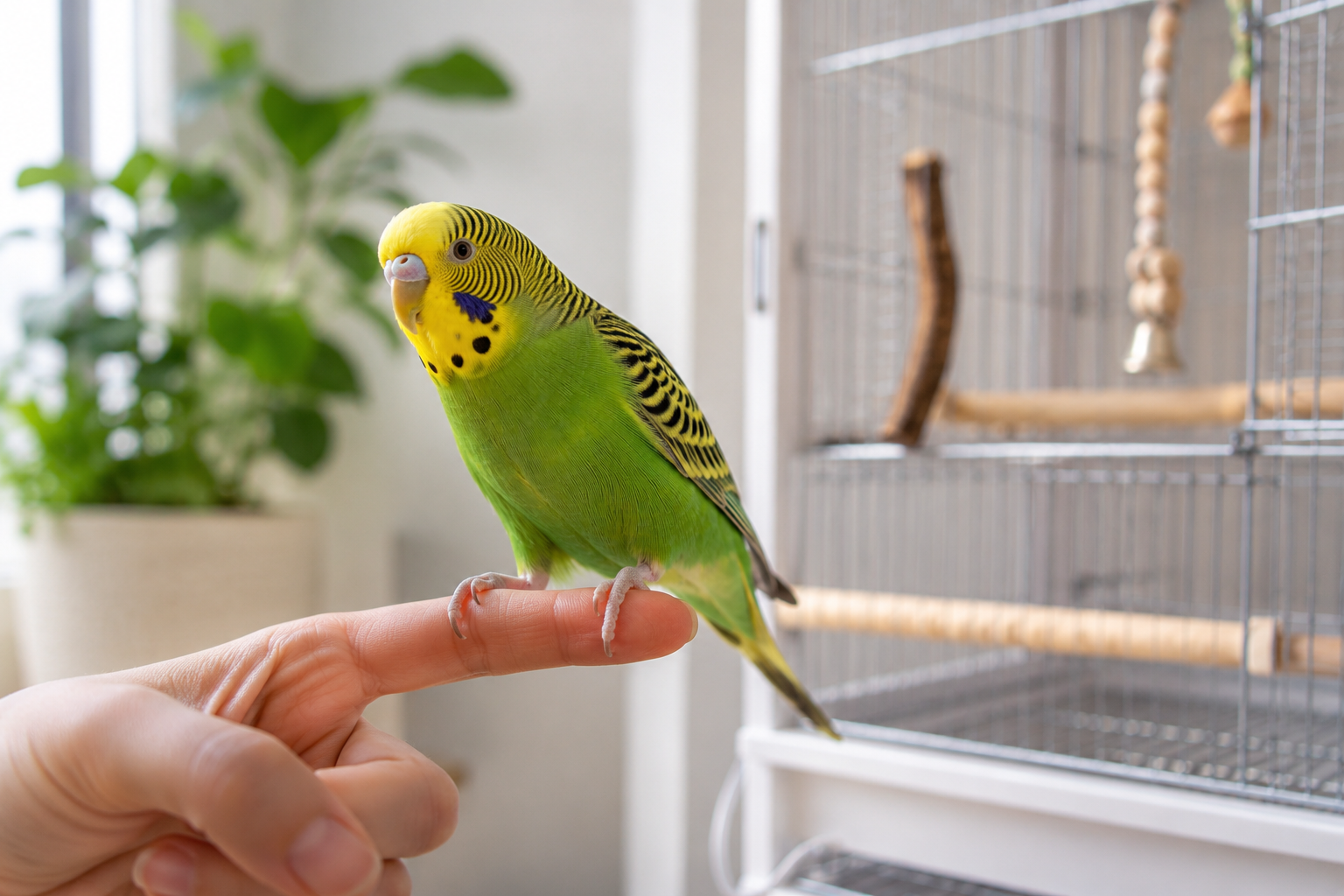
Step up is a simple behavior where a bird voluntarily steps onto your finger hand or handheld perch.
It can make normal care easier.
A bird that understands step up may be easier to:
- Move safely between locations
- Return to the cage
- Handle during routine care
- Interact with without grabbing
The goal should be cooperation rather than control.
Build Trust Before Asking for Step Up
A new budgie may not understand that your hands are safe.
Hands are large compared with a small bird and can be frightening when they move quickly.
Spend several days or longer simply allowing the bird to become familiar with you if necessary.
You can:
- Sit near the cage
- Speak quietly
- Move slowly
- Offer a favorite food through the cage bars
- Place your hand near the cage without reaching for the bird
Do not measure progress by how quickly someone else's budgie became tame.
Individual birds develop trust at different speeds.
Prepare a Safe Training Area
Before opening the cage make the room safe.
Close:
- Windows
- Exterior doors
- Ceiling fans
Keep other pets out of the room.
Remove obvious hazards such as uncovered hot surfaces open water containers toxic plants and places where the bird could become trapped.
If you are still improving your bird's enclosure read our guide on how to set up a safe bird cage for a budgie or cockatiel.
Choose a Small Reward
Positive reinforcement means giving the bird something it likes after a behavior you want to encourage.
For many budgies a tiny amount of millet can be useful.
The reward should be small so the bird can eat it quickly and continue training.
Do not remove normal food to make the bird hungry enough to cooperate.
Start With a Handheld Perch if Your Bird Is Nervous
A budgie that is afraid of fingers may accept a familiar looking perch more easily.
Use a lightweight stable perch.
Move it slowly toward the bird at foot level.
Reward your budgie for:
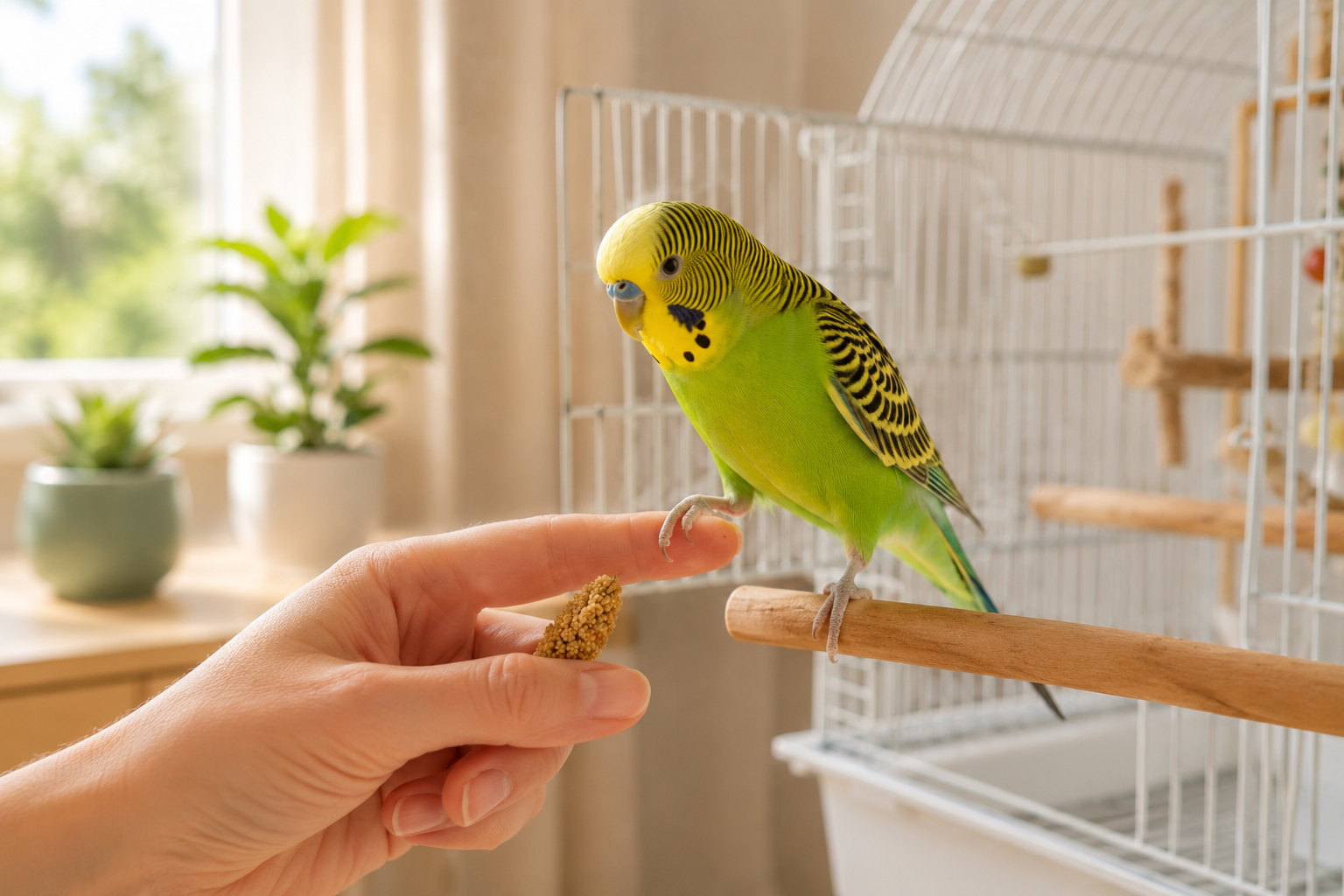
- Remaining calm near the perch
- Touching it
- Placing one foot on it
- Eventually stepping fully onto it
Do not push hard against the bird's body.
Teach Step Up Onto Your Finger
Once your budgie is comfortable with your hand nearby hold your finger horizontally near the bird's feet.
Approach from the front where the bird can see you.
Keep your movements slow.
If the budgie leans away stop moving closer.
If the bird remains calm allow it time to investigate.
Reward Small Progress
You do not need to wait for the complete behavior before rewarding.
Reward steps such as:
- Looking toward your finger
- Moving closer
- Touching your finger
- Putting one foot on
- Stepping fully onto the finger
This makes training easier to understand.
Add a Simple Verbal Cue
Once the bird begins stepping onto your finger reliably you can say a consistent phrase such as Step up just before presenting your hand.
Keep the cue simple.
Do not repeat it continuously.
The bird learns that the cue predicts the opportunity to perform the behavior and receive reinforcement.
Keep Training Sessions Short
Long sessions can cause frustration.
Several short sessions are usually better than one exhausting session.
For a beginner bird even a few minutes may be enough.
Finish while your bird is still calm.
A successful session might include only two or three good repetitions.
What if Your Budgie Is Afraid of Your Hand?
Go back to an easier step.
Place your hand farther away and reward calm behavior.
Gradually reduce the distance over multiple sessions.
Do not corner the bird inside the cage.
A trapped bird may panic and learn that your hand predicts danger.
What if Your Budgie Bites?
Biting may occur because the bird is frightened uncomfortable overstimulated or trying to create distance.
Do not hit shout at or flick the bird.
Instead consider what happened immediately before the bite.
Did you:
- Move too quickly?
- Continue after the bird leaned away?
- Reach into a place the bird was defending?
- Make the session too long?
Adjust the training plan rather than punishing the bird.
Learn Basic Budgie Body Language
Training becomes easier when you notice subtle signals.
A relaxed bird may:
- Remain comfortably perched
- Accept treats
- Show normal curiosity
- Approach voluntarily
A frightened bird may:
- Lean away
- Move rapidly to the opposite side
- Try to escape
- Breathe faster
- Freeze
- Bite when approached
Respecting these signals builds trust.
Practice Outside the Cage Later
Once the bird reliably steps up inside or near the cage you can practice in a safe room.
Keep the first sessions close to the cage.
Do not carry a newly trained bird around the entire house immediately.
If the bird flies away remain calm.
Allow it to land and offer the familiar perch or finger again.
Do Not Clip Wings Just to Make Training Easier
Training should be based on trust and reinforcement rather than making escape physically impossible.
Wing clipping can affect normal flight behavior and may have welfare and safety consequences.
Discuss individual flight and medical concerns with an avian veterinarian.
Common Budgie Training Mistakes
Trying to Train Immediately After Bringing the Bird Home
The bird may need time to feel secure first.
Grabbing the Bird
Forced handling can damage trust.
Making Training Sessions Too Long
Stop while the bird is still engaged.
Punishing Biting
Punishment can increase fear.
Moving the Hand Too Quickly
Slow predictable movement is easier for the bird to understand.
Expecting Progress Every Day
Training is not always perfectly linear.
Training in an Unsafe Room
Secure windows fans doors and other hazards first.
Frequently Asked Questions
How Long Does It Take to Teach a Budgie to Step Up?
It varies. Some birds learn quickly while frightened or poorly socialized birds may need much more time.
Should I Push My Finger Against the Budgie's Chest?
Avoid using force. Present your finger or perch gently and reward voluntary stepping.
What Treat Is Good for Budgie Training?
A tiny amount of a favorite safe food such as millet is commonly used. Keep training rewards small.
Can an Older Budgie Learn Step Up?
Yes. Adult birds can learn new behaviors although previous experiences may influence how quickly they become comfortable.
Why Does My Budgie Fly Away From My Hand?
The bird may not trust the hand yet or the approach may be too fast. Return to easier trust building exercises.
Should I Catch My Budgie if It Refuses to Step Up?
Do not chase or catch a healthy bird simply to complete a training session. End the session and try again later.
Related DailyPetTips Guides
Sources and References
Bird Safety Disclaimer
This article provides general educational training information. Contact an avian veterinarian if your bird shows breathing problems weakness abnormal balance significant appetite changes injury or other concerning symptoms.
Editorial Note
This guide uses positive reinforcement and voluntary participation. It intentionally avoids punishment chasing forced handling and other methods that can increase fear.
About the Author
Ibrahim is a pet care writer at DailyPetTips. He creates practical easy to understand guides using responsible animal care principles and established veterinary and animal welfare resources.


Pet parent notes