Quick Answer
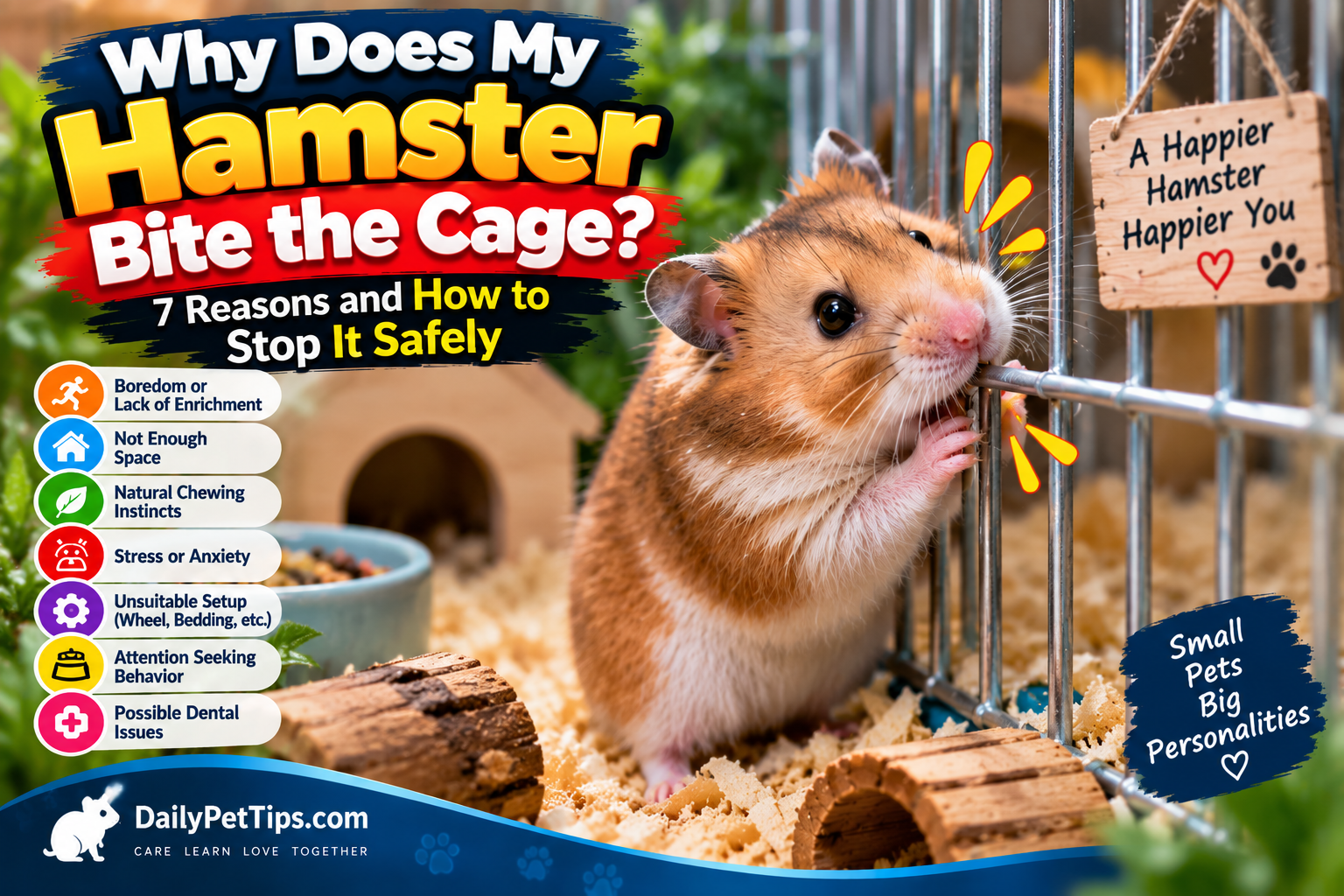
A hamster may bite or chew cage bars because it is trying to explore, needs more enrichment, has learned that bar biting gets attention, feels stressed, or does not have enough suitable space and substrate for natural behaviors.
Hamsters naturally gnaw, but repeatedly chewing metal bars is not something owners should simply encourage as a way to wear down the teeth. Persistent bar biting can indicate that the hamster's environment needs improvement and may eventually injure the mouth or damage the teeth.
Instead of punishing the behavior, review the entire setup: enclosure size, bedding depth, wheel, hiding places, chew materials, foraging opportunities, noise, handling and daily routine.
Key Takeaways
- Hamsters naturally chew, but persistent metal bar biting deserves attention.
- An enclosure that limits normal exploration can contribute to frustration.
- Hamsters need deep, safe substrate because burrowing is an important natural behavior.
- A properly sized exercise wheel is an essential part of the enclosure.
- Safe chew materials should be available, but simply adding one chew toy may not solve chronic bar biting.
- Stress and excessive disturbance can increase repetitive behaviors.
- Giving treats every time the hamster bites the bars can accidentally reinforce the behavior.
- Never punish bar biting by hitting the cage, shouting or spraying the hamster.
- Check the mouth and teeth if chewing behavior changes suddenly or the hamster has difficulty eating.
Is Cage Bar Biting Normal for Hamsters?
Chewing itself is completely normal for hamsters.
Hamsters are rodents, and their incisor teeth continue growing throughout life. They need appropriate opportunities to gnaw and use their teeth.
However, chewing safe natural materials is different from spending long periods repeatedly biting metal cage bars.
An occasional investigation of the bars may not be concerning. Persistent repetitive bar chewing, especially when combined with climbing, pacing or escape attempts, can suggest that something about the hamster's environment or routine is not meeting its behavioral needs.
Why You Should Not Ignore Constant Bar Biting
Repeatedly chewing hard metal may cause physical problems.
Potential concerns include:
- Damage to the incisors
- Abnormal tooth wear
- Irritation around the nose or mouth
- Hair loss where the face repeatedly rubs against bars
- Wounds around the mouth
The behavior can also be useful information about your hamster's welfare.
Rather than trying only to stop the sound, ask what is motivating the behavior.
1. The Enclosure May Not Provide Enough Usable Space
Hamsters are small animals, but that does not mean they need tiny homes.
In the wild, hamsters may travel considerable distances while searching for food and maintaining burrow systems.
A cramped enclosure limits opportunities to explore, forage, dig and move naturally.
When a hamster repeatedly approaches the boundaries of its enclosure and chews at them, frustration may be part of the explanation.
Think Beyond Floor Dimensions Alone
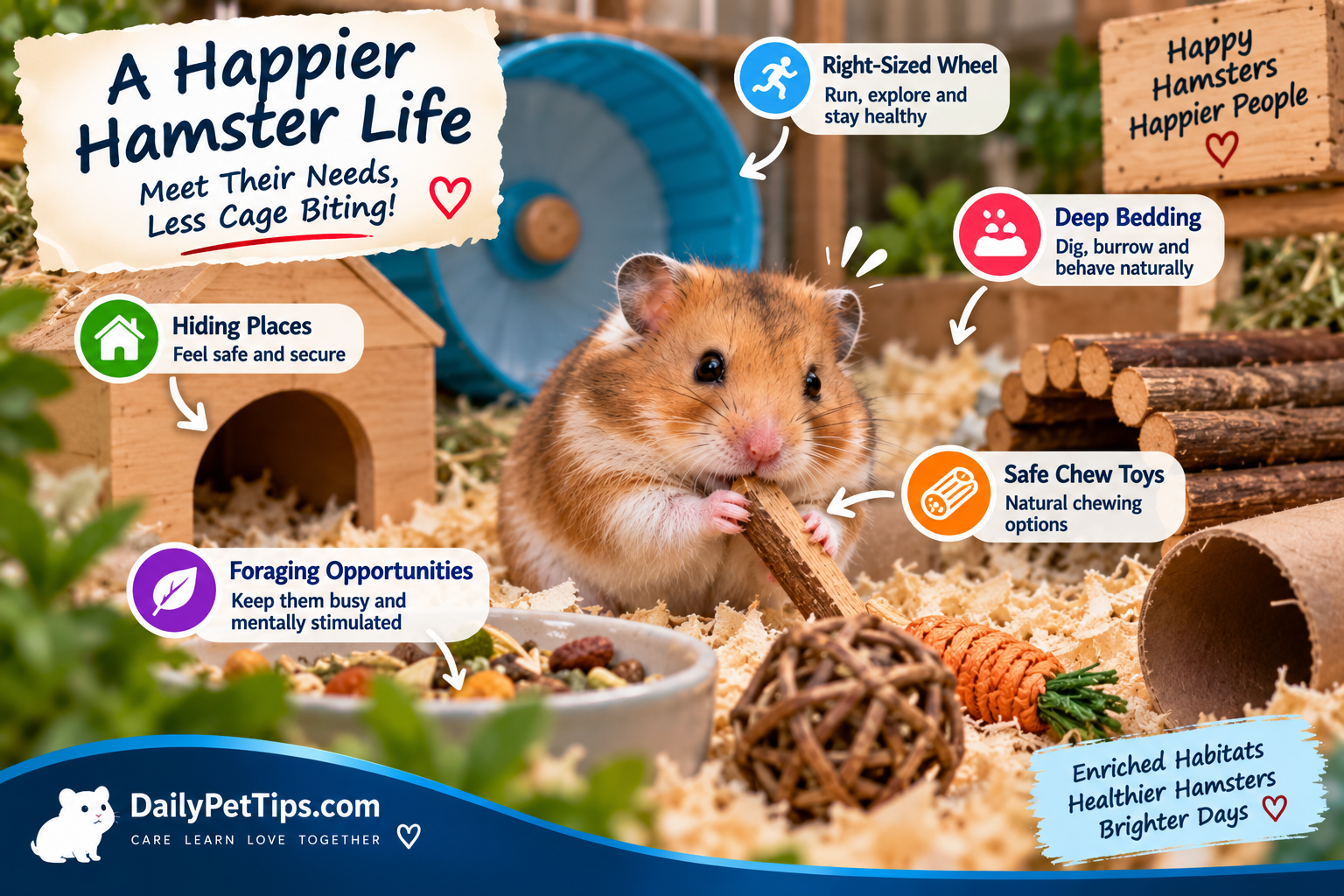
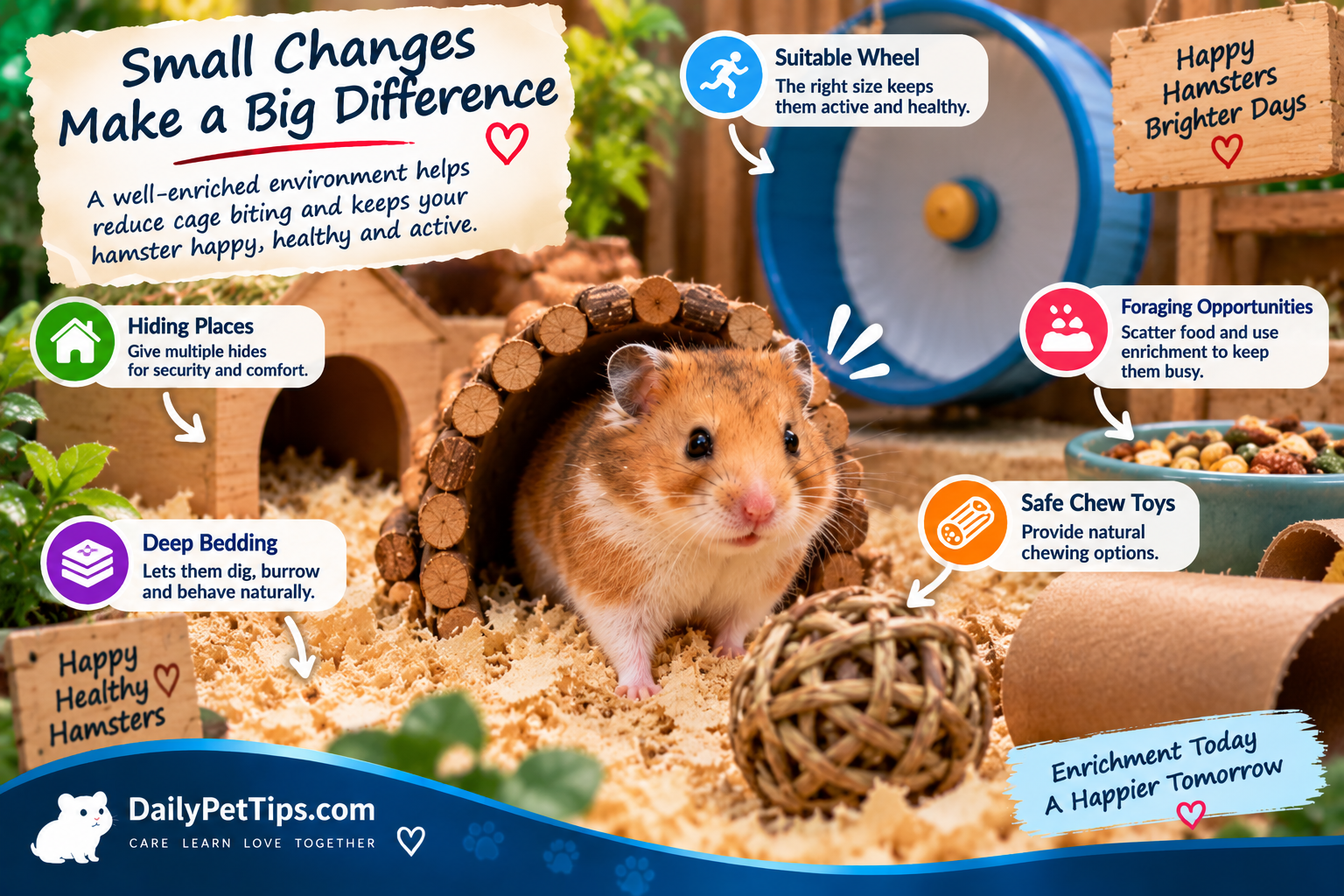
A good hamster setup needs room for multiple resources at the same time, including:
- A suitable wheel
- Deep bedding
- Several hiding areas
- A sand area where appropriate
- Food and water
- Foraging enrichment
- Chewing materials
- Open pathways for movement
An enclosure can become functionally cramped when equipment fills almost every available area.
Will a Bigger Cage Automatically Stop Bar Biting?
Not necessarily.
Space is only one part of good husbandry.
A larger but almost empty enclosure may still provide little behavioral stimulation. The goal is sufficient usable space combined with an environment that allows the hamster to perform natural behaviors.
2. Your Hamster May Be Bored or Under-Stimulated
A hamster needs more to do than eat from a bowl and run on a wheel.
Natural hamster behavior includes:
- Searching for food
- Digging
- Burrowing
- Exploring
- Gnawing
- Collecting nesting material
- Moving through tunnels and covered spaces
If the enclosure offers few opportunities for these activities, the hamster may develop repetitive behaviors.
How to Add Useful Enrichment
Try providing a changing selection of safe activities such as:
- Cardboard tunnels
- Plain cardboard boxes
- Safe wooden chew items
- Foraging opportunities
- Appropriate digging areas
- Multi-chamber hides
- Safe nesting material
- Different textures of hamster-safe substrate
Enrichment should encourage normal behavior rather than simply make the enclosure look decorative.
3. Your Hamster Needs Better Burrowing Opportunities
Burrowing is one of the most important hamster behaviors to consider when designing an enclosure.
A thin layer of bedding may cover the floor but does not necessarily allow a hamster to build a stable burrow.
Where the enclosure permits, provide a generous depth of safe, compactable substrate so the hamster can dig and create tunnels.
More depth may be especially useful in part of the enclosure if equipment such as the wheel requires a lower area.
Why Burrowing Matters
A burrow can give a hamster:
- A secure sleeping location
- Protection from light
- A place to store food
- Control over its environment
- An outlet for natural digging behavior
A hamster that can create its own sheltered spaces may feel more secure than one with nowhere to retreat.
4. The Wheel May Be Missing or Unsuitable
Exercise wheels allow hamsters to perform sustained locomotor activity within a limited environment.
However, not every wheel is appropriate.
A wheel should be large enough for the hamster to run without having to keep its spine strongly curved.
It should also have a solid running surface rather than an unsafe open-wire surface that may trap feet or limbs.
Signs the Wheel May Be Too Small
- The hamster runs with a strongly arched back
- The hamster appears cramped while running
- The animal struggles to maintain a comfortable stride
- A larger hamster can barely fit on the running surface
Different hamster species and individuals vary in body size, so select equipment based on the actual animal rather than assuming one wheel size fits every hamster.
5. Your Hamster Needs Safe Things to Chew
Gnawing is normal rodent behavior.
Provide appropriate materials that allow your hamster to chew without relying on metal bars.
Depending on the product and species, options may include:
- Hamster-safe untreated wood
- Plain cardboard
- Species-appropriate chew products
- Safe natural materials specifically sold for small animals
Always check that wood or plant materials are non-toxic, untreated and free from pesticides, paint, glue or harmful coatings.
Chew Toys Are Not a Complete Solution
If a hamster has several chew items but still spends long periods biting the bars, do not assume it simply needs another wooden stick.
Review space, substrate depth, wheel quality, hiding areas, stress and enrichment as a complete system.
6. Stress May Be Triggering the Behavior
Hamsters can become stressed by an environment that feels unpredictable or unsafe.
Potential stressors include:
- Frequent waking during the day
- Constant loud noise
- Repeated grabbing
- Other pets staring into the enclosure
- Moving the enclosure frequently
- Bright lighting during normal resting periods
- Insufficient hiding places
- Incompatible social housing
A hamster needs periods when it can sleep and hide without being disturbed.
Remember That Hamsters Are Primarily Active at Night
Hamsters are generally most active during evening and nighttime periods.
If you repeatedly wake a sleeping hamster during the day for handling, the animal may become stressed and defensive.
Whenever possible, interact when your hamster wakes naturally.
7. Bar Biting May Have Become a Learned Attention-Seeking Behavior
Hamsters can learn from consequences.
Imagine this pattern:
Hamster bites bars → owner walks over → hamster receives a treat.
If this happens repeatedly, bar biting can become a reliable way to make something interesting happen.
What Should You Do?
First make sure the enclosure and welfare needs are genuinely appropriate.
If the hamster is healthy and the environment is suitable, try giving desirable things such as treats, enrichment or supervised interaction during calm behavior rather than immediately after bar biting.
This avoids deliberately rewarding the behavior you want to reduce.
Why Does My Hamster Bite the Cage at Night?
Nighttime bar biting is particularly common because that is when many hamsters become active.
During the day your hamster may be asleep while you are watching the enclosure.
At night it wakes and begins exploring, running, digging and foraging.
If the environment does not provide enough outlets for that activity, repetitive bar chewing may become more noticeable.
Before trying to stop nighttime noise, make sure the hamster has:
- Appropriate space
- A suitable wheel
- Deep substrate
- Hiding areas
- Foraging opportunities
- Safe chew materials
Why Is My Hamster Climbing and Biting the Bars?
Repeated bar climbing combined with chewing may indicate strong motivation to explore beyond the enclosure.
Again, this does not prove that one specific husbandry problem exists.
Look at the complete setup.
If almost all usable space is occupied by a small wheel, food dish and one hide, the hamster may have few opportunities for meaningful activity.
Why Does My Hamster Bite the Cage After I Put It Back?
A hamster that has been exploring outside its enclosure may immediately investigate the boundaries when returned.
It may have learned that bar biting sometimes results in being taken out again.
Do not use bar chewing as the only signal for out-of-enclosure activity.
Instead, create a predictable routine and provide supervised exploration in a secure hamster-safe area when appropriate.
Is My Hamster Trying to Escape?
Possibly.
Hamsters are naturally curious and may investigate possible exits even in a well-designed enclosure.
Occasional exploration is different from persistent repetitive escape behavior.
If escape attempts are frequent, review the environment rather than assuming your hamster is simply mischievous.
Also make sure lids, doors and ventilation openings are secure because hamsters can squeeze through surprisingly small gaps.
Can Bar Biting Damage a Hamster's Teeth?
Yes, persistent chewing on hard metal may contribute to dental damage or abnormal wear.
Check your hamster if you notice:
- A chipped or broken incisor
- Difficulty picking up food
- Drooling
- Reduced appetite
- Weight loss
- Blood around the mouth
- Swelling around the face
Dental problems require veterinary assessment.
What Should Healthy Hamster Incisors Look Like?
Hamster incisors are naturally different from human teeth and may have a yellowish to orange coloration.
They should align in a way that allows normal eating and gnawing.
Overgrown, broken or misaligned teeth can interfere with feeding.
Do not attempt to cut hamster teeth at home with nail clippers or similar household tools. Incorrect trimming can split or fracture the tooth and injure the mouth.
A veterinarian experienced with small mammals can evaluate abnormal teeth and determine appropriate treatment.
How to Stop Hamster Cage Biting Safely
There is no single trick that works for every hamster.
Use a step-by-step approach.
Step 1: Review Enclosure Space
Make sure your hamster has enough usable floor area for normal movement and essential resources.
Step 2: Increase Appropriate Bedding Depth
Provide enough safe substrate for meaningful digging and burrowing where possible.
Step 3: Check the Wheel
Make sure it has a solid surface and allows your hamster to run comfortably without excessive spinal curvature.
Step 4: Add Multiple Hiding Options
Give your hamster places where it can retreat completely from view.
Step 5: Add Safe Chewing Materials
Provide appropriate alternatives to metal bars.
Step 6: Encourage Foraging
Instead of placing every piece of dry food in one bowl, some of the normal ration can be scattered or hidden safely around the enclosure when appropriate.
This encourages searching behavior.
Step 7: Reduce Stress
Keep the enclosure in a stable location away from constant disturbance, strong drafts and intense daytime activity.
Step 8: Avoid Rewarding Bar Biting
Give attention and treats during calmer behavior rather than automatically responding to every chewing episode.
Step 9: Monitor the Mouth and Teeth
If the hamster has been chewing metal extensively, check for visible injury and seek veterinary advice if anything looks abnormal.
Would a Tank-Style Enclosure Stop Bar Biting?
An appropriately ventilated enclosure with solid sides removes access to metal bars, so the specific behavior of bar chewing cannot continue in the same way.
However, simply removing the bars does not automatically solve the underlying motivation.
A solid-sided enclosure still needs:
- Adequate ventilation
- Sufficient floor space
- Deep substrate
- A suitable wheel
- Hiding places
- Enrichment
- Safe temperature
If the original problem was an impoverished environment, moving the hamster into an equally empty container is not a meaningful welfare improvement.
Can I Put Something on the Bars to Stop Chewing?
Avoid applying bitter sprays, hot substances, essential oils, household chemicals or other deterrents to cage bars.
Hamsters groom themselves and may ingest residues.
Some substances that seem harmless to humans can irritate or harm small animals.
Fix the underlying husbandry problem instead of coating the enclosure with unpleasant substances.
Should I Spray My Hamster With Water?
No.
Do not spray a hamster with water as punishment for bar biting.
It can create fear and stress without teaching the hamster what it should do instead.
Hamsters should not be punished for expressing behavior that may reflect unmet needs.
Should I Tap the Cage When My Hamster Bites It?
No.
Hitting or tapping the enclosure may frighten the hamster and increase stress.
Remember that your goal is not simply to make the noise stop.
Your goal is to create an environment in which the hamster has better behavioral options.
Do Mineral Blocks Stop Hamster Bar Biting?
Do not assume that a mineral block or salt lick is necessary simply because your hamster chews.
A hamster receiving an appropriate complete diet should not automatically require random mineral supplementation.
Chewing behavior is not proof of a mineral deficiency.
Discuss supplementation with a veterinarian if you have concerns about your hamster's nutrition.
Can More Free-Roaming Time Fix the Problem?
Supervised exercise outside the enclosure can provide useful enrichment when done safely, but it should complement rather than compensate for poor permanent housing.
Your hamster spends much of its life in its primary enclosure.
That environment still needs to support normal behavior even if the hamster receives additional exploration time.
Use a Secure Play Area
If you provide out-of-enclosure activity, make sure the area is escape-proof and free from hazards.
Remove access to:
- Electrical wires
- Toxic plants
- Small gaps
- Other pets
- Unsafe foods
- Objects that could fall
- Deep water
Supervise the hamster appropriately.
What About Hamster Balls?
Traditional enclosed exercise balls can create welfare and safety concerns because the hamster cannot freely exit, has limited access to normal sensory information and may collide with objects or fall from elevated surfaces.
A secure playpen or hamster-proofed exploration area generally provides more control over movement and allows access to hides and normal environmental cues.
Scatter Feeding Can Add Enrichment
Hamsters naturally spend time searching for food.
Instead of always serving the entire dry ration in one dish, you can scatter part of an appropriate diet through clean substrate or hide small amounts in safe locations.
This turns feeding into an activity.
Keep track of how much food is being provided because hamsters often store food in caches.
Check Food Stores During Cleaning
Hamsters may create hidden food stores inside their burrows.
Do not unnecessarily destroy the entire nest and food cache at every cleaning.
However, remove spoiled fresh food and contaminated material.
Large full-enclosure cleans can remove familiar scents and may be stressful, so spot cleaning and partial substrate replacement can often preserve more of the hamster's established environment when hygiene allows.
Does Cage Cleaning Cause Bar Biting?
Some hamsters become more active or unsettled after major enclosure changes.
A complete clean removes familiar scent markers and can destroy carefully constructed burrows.
Good hygiene is important, but excessive cleaning can be disruptive.
Balance cleanliness with environmental stability.
Could Another Hamster Be Causing Stress?
Yes.
Social needs vary between hamster species, and inappropriate co-housing can cause severe stress or fighting.
Syrian hamsters are generally solitary and should be housed individually.
Even species sometimes described as more socially tolerant can develop aggression, and co-housing requires careful species-specific knowledge.
Never add another hamster as a treatment for boredom or cage biting.
Why Is My Syrian Hamster Biting the Bars?
The same general causes apply: insufficient usable space, limited burrowing opportunities, lack of enrichment, an unsuitable wheel, stress or learned behavior.
Syrian hamsters are comparatively large, so equipment and enclosure dimensions must accommodate their larger body size.
They also require individual housing.
Why Is My Dwarf Hamster Biting the Cage?
Dwarf hamsters can also chew bars because of exploration, frustration, stress or lack of enrichment.
The fact that a dwarf hamster is physically smaller does not mean it needs an extremely small or empty enclosure.
It still requires appropriate space, substrate, hides, a suitable wheel and opportunities for natural behavior.
How Long Does It Take for Bar Biting to Stop?
There is no guaranteed timeline.
If the behavior is driven by an inadequate setup, you may see improvement after meaningful environmental changes.
If it has become a well-established habit, it may persist for some time even after the original trigger is addressed.
Focus on improving welfare rather than expecting instant silence.
Keep a Simple Behavior Log
If you cannot identify the trigger, record the behavior for several nights.
Write down:
- What time bar biting starts
- How long it lasts
- What the hamster was doing beforehand
- Whether food was recently provided
- Whether you approached the enclosure
- Whether another pet was nearby
- Whether the hamster used its wheel and burrows normally
A pattern may become obvious after several observations.
Signs Your Hamster's Setup May Need Improvement
One behavior alone cannot perfectly measure welfare, but review the environment if you repeatedly notice:
- Persistent bar biting
- Constant escape attempts
- Repetitive climbing
- Very limited burrowing
- No suitable hiding area
- An obviously undersized wheel
- Little opportunity to forage or explore
When Bar Biting May Need Veterinary Attention
A sudden change in chewing behavior can sometimes occur alongside dental disease, pain or another health problem.
Contact a veterinarian experienced with hamsters or other small mammals if your hamster has:
- Difficulty eating
- Drooling
- Weight loss
- A broken tooth
- Very long or misaligned incisors
- Bleeding around the mouth
- Facial swelling
- Severe lethargy
- Breathing difficulty
- A sudden major behavior change
Hamsters are small prey animals and can deteriorate quickly when seriously ill, so significant symptoms should not be ignored.
A Simple Cage-Biting Fix Checklist
Before buying another toy, work through this checklist:
- Does my hamster have enough usable enclosure space?
- Can it create meaningful burrows?
- Is the wheel large enough?
- Does the wheel have a safe solid running surface?
- Are there multiple secure hiding areas?
- Does the hamster have safe chewing materials?
- Can it forage and explore?
- Is the enclosure protected from constant disturbance?
- Am I waking the hamster unnecessarily?
- Am I accidentally rewarding bar biting?
- Are the teeth and mouth healthy?
Improving several areas together is often more useful than searching for one magic product.
Frequently Asked Questions
Why Does My Hamster Bite the Cage Bars?
Possible reasons include frustration, insufficient space, limited enrichment, lack of burrowing opportunities, stress, natural chewing behavior or a learned response that gets attention.
Is It Bad for Hamsters to Bite Metal Bars?
Persistent metal chewing can damage the teeth or irritate the mouth and face. It can also indicate that the hamster's environment needs improvement.
How Do I Get My Hamster to Stop Biting the Cage?
Review the entire enclosure. Provide sufficient usable space, deep safe substrate, a suitable wheel, hiding places, safe chew materials and foraging opportunities while reducing unnecessary stress.
Why Does My Hamster Bite the Cage at Night?
Hamsters are generally most active at night, so this is when exploration and repetitive behaviors may become most noticeable. Make sure the enclosure provides appropriate nighttime activity.
Does My Hamster Need More Chew Toys?
Possibly, but chew toys alone may not solve persistent bar biting. Space, substrate depth, wheel quality, enrichment and stress should also be reviewed.
Should I Give My Hamster a Treat When It Bites the Bars?
Not routinely. If treats consistently follow bar biting, the hamster may learn that chewing the bars produces a reward.
Can I Spray Something on the Bars to Stop My Hamster Chewing?
Avoid bitter sprays, essential oils and household deterrents. Residues may be irritating or unsafe if ingested. Address the reason for the behavior instead.
Will Moving My Hamster to a Tank Stop Cage Biting?
A solid-sided enclosure removes access to bars, but it will not automatically fix boredom, stress or inadequate husbandry. The new enclosure must still provide adequate ventilation, space, bedding and enrichment.
Can Cage Biting Break a Hamster's Teeth?
Persistent hard chewing can contribute to dental damage. Seek veterinary advice if a tooth appears broken, overgrown or misaligned or if your hamster has difficulty eating.
Should I Get Another Hamster So Mine Is Not Bored?
No. Another hamster should not be used as an enrichment solution. Syrian hamsters are solitary, and inappropriate co-housing can lead to serious stress or fighting.
Related DailyPetTips Guides
Sources and Further Reading
- RSPCA — Hamster Care and Welfare
- Blue Cross — Hamster Care Advice
- Merck Veterinary Manual — Hamsters
- Woodgreen Pets Charity — Hamster Advice
Hamster Health Disclaimer
This article provides general educational information and is not a substitute for veterinary diagnosis or treatment. Persistent cage biting can reflect environmental or behavioral factors, while changes in chewing or eating can also accompany dental or medical problems. Contact a veterinarian experienced with small mammals if your hamster develops difficulty eating, drooling, weight loss, broken or abnormal teeth, facial swelling, breathing problems, severe lethargy or another significant health change.
Editorial Note
This guide approaches cage biting as a behavior that may communicate unmet environmental needs rather than something to punish. Recommendations prioritize usable space, burrowing, exercise, foraging, safe chewing opportunities, environmental stability and recognition of possible dental or medical problems.
About the Author
Ibrahim is a pet care writer at DailyPetTips. He creates practical, easy-to-understand pet guides using established veterinary, animal welfare and husbandry information, with an emphasis on safe and responsible everyday care.

Pet parent notes