

Quick Answer
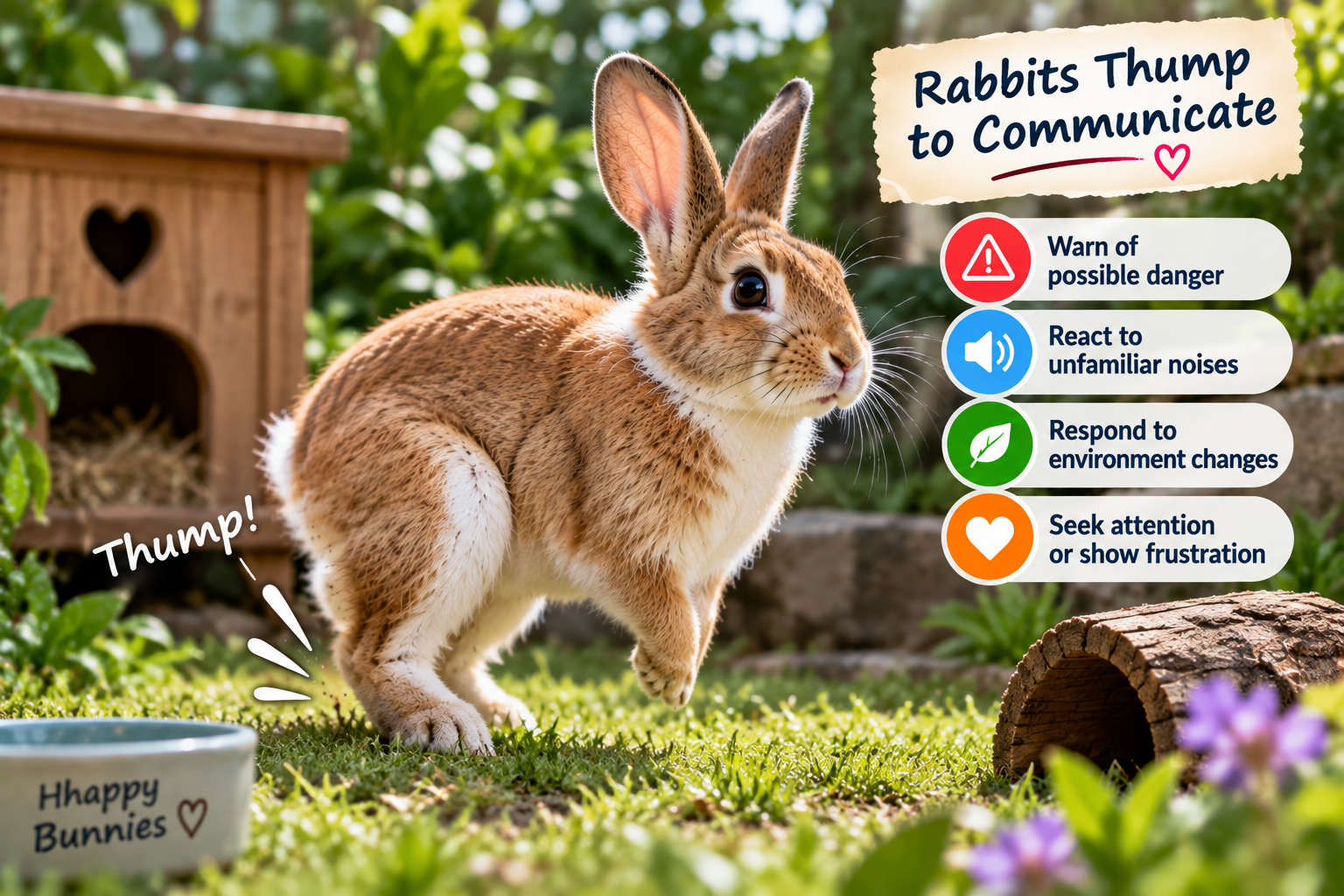
Rabbits usually thump their powerful hind feet as a form of communication. A thump can mean that your rabbit has noticed possible danger, feels frightened or irritated, wants attention, or is reacting to something unusual in the environment.
Occasional thumping is often normal rabbit behavior. What matters is the context.
If your rabbit suddenly begins thumping repeatedly and also stops eating, hides constantly, sits in an unusual posture, becomes extremely inactive, has difficulty breathing, or produces fewer droppings than normal, do not assume it is simply being dramatic. Rabbits can hide illness surprisingly well, so behavioral changes deserve attention.
Key Takeaways
- Thumping is a natural form of rabbit communication.
- Fear and perceived danger are common triggers.
- Unfamiliar sounds, smells, people, animals or objects may cause thumping.
- Some rabbits thump when frustrated or seeking interaction.
- Repeated nighttime thumping can be triggered by sounds humans barely notice.
- Never punish a rabbit for thumping.
- Look at body language, appetite, droppings and activity to understand the behavior.
- Sudden behavioral changes accompanied by signs of illness require veterinary attention.
What Does It Mean When a Rabbit Thumps?
A rabbit thump is produced when the rabbit forcefully strikes one or both hind feet against the ground.
For a prey animal, communication about danger can be extremely valuable. A loud vibration can alert nearby rabbits while the animal remains relatively close to cover.
Domestic rabbits retain many behaviors associated with their wild relatives, even when they live safely indoors.
Your rabbit therefore does not need to be in actual danger to thump. It only needs to perceive something as potentially threatening or important.
Look at the Whole Rabbit, Not Just the Feet
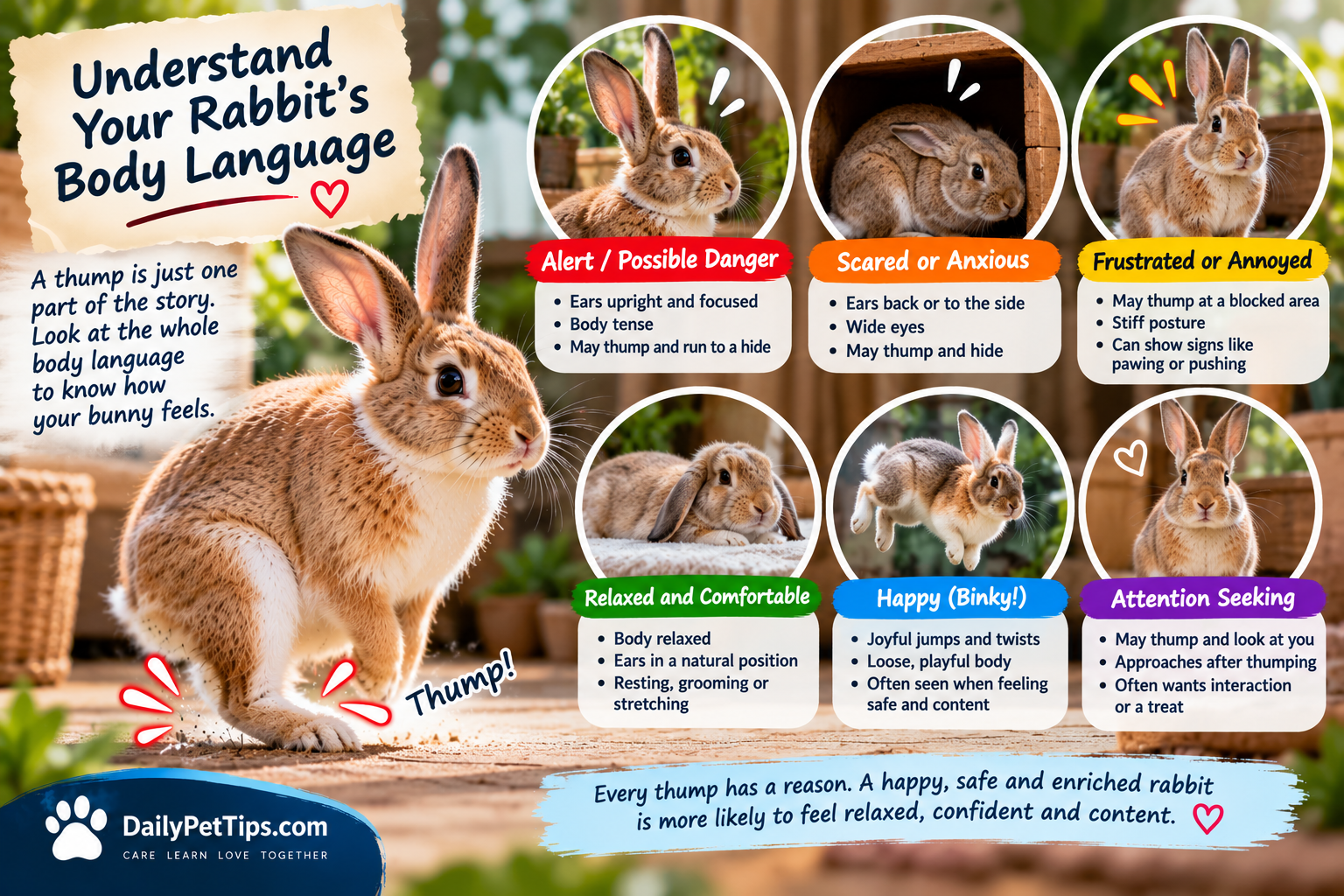
A thump by itself does not tell you exactly what a rabbit is feeling.
Observe the rest of its body language.
A frightened or highly alert rabbit may:
- Hold its body tense
- Raise or orient its ears toward a sound
- Freeze suddenly
- Stare toward a particular area
- Run toward a hiding place
- Remain unusually alert
A relaxed rabbit will generally show much softer body language.
1. Your Rabbit Thinks There Is Danger
This is one of the classic explanations for rabbit thumping.
Your rabbit may hear, see or smell something that triggers its prey-animal instincts.
The perceived threat could be obvious, such as a barking dog nearby.
It can also be something that seems completely harmless to you.
Possible triggers include:
- A dog or cat outside a window
- A sudden movement
- A person entering unexpectedly
- A loud vehicle
- A vacuum cleaner
- A dropped object
- A strange animal scent
- An unfamiliar household noise
What Should You Do?
Stay calm and look for the source of the disturbance.
Give your rabbit access to a secure hiding place rather than forcing it into the open.
If there is an obvious stressor, reduce or remove it when practical.
2. Your Rabbit Heard Something You Didn't
Rabbits are highly alert to their surroundings.
A sound that you barely notice may be significant to your rabbit.
This can explain seemingly mysterious thumping, particularly at night when the home becomes quieter.
Your rabbit may notice:
- People outside
- Wildlife
- Another pet moving around
- Pipes or heating systems
- Doors opening elsewhere in the building
- Outdoor machinery
- Unexpected electronic sounds
Before concluding that your rabbit is thumping "for no reason," spend a few minutes quietly observing the environment.
3. Something New Has Made Your Rabbit Nervous
Rabbits can be cautious about changes in familiar surroundings.
You may have introduced something that seems ordinary to you but looks completely different from your rabbit's perspective.
Examples include:
- New furniture
- A large cardboard box
- A new pet
- A visitor
- A new vacuum cleaner
- Different flooring
- A moved enclosure
- An unfamiliar scent
Give your rabbit time to investigate new objects voluntarily.
Do not chase or carry a frightened rabbit toward the object to "show" that it is safe.
4. Your Rabbit Is Frustrated or Annoyed
Not every thump means terror.
Some rabbits thump when frustrated or displeased.
For example, a rabbit may become frustrated when:
- It wants to leave an enclosure
- A door blocks access to a favorite area
- You interrupt an activity
- Food does not arrive when expected
- Another rabbit occupies a desired space
Context and accompanying body language help distinguish irritation from fear.
A rabbit that confidently approaches you, thumps and continues demanding interaction is presenting a different picture from a rabbit that thumps and immediately hides.
5. Your Rabbit Has Learned That Thumping Gets Attention
Animals can learn which behaviors produce predictable responses from people.
Imagine that your rabbit thumps one evening and you immediately walk over with a treat.
If this happens repeatedly, the rabbit may learn:
Thump → human arrives → something interesting happens.
This does not mean the rabbit is being manipulative in a human sense. It simply means behavior can be reinforced by its consequences.
Be Careful With Accidental Reinforcement
You should still check that a thumping rabbit is safe.
However, if you are confident that the rabbit is healthy and repeatedly thumping solely to request treats, avoid turning every thump into a snack delivery.
6. Your Rabbit Is Experiencing Environmental Stress
Chronic environmental stress can affect rabbit behavior.
Potential stressors include:
- Constant loud noise
- No secure hiding areas
- Frequent unwanted handling
- Insufficient space
- Unpredictable interaction with predators such as dogs or cats
- An incompatible companion
- Repeated disruption of the rabbit's resting area
A rabbit needs more than food and water. Its environment should allow normal behaviors such as hiding, exploring, resting, stretching and foraging.
For additional husbandry information, browse our Rabbit Care Guides.
7. Hormonal or Social Behavior May Contribute
Rabbit behavior can also be influenced by reproductive hormones and social interactions.
Unneutered rabbits may show stronger territorial, sexual or socially reactive behaviors.
Thumping can occur during interactions between rabbits, especially when one animal is uncertain, excited or defensive.
Do not assume that two rabbits will automatically become friends simply because they are the same species.
Rabbit introductions should be managed carefully, and fighting rabbits may seriously injure each other.
Discuss spaying or neutering with a rabbit-experienced veterinarian, including the appropriate timing and individual health considerations.
8. Your Rabbit May Be Uncomfortable or Unwell
Thumping is not a specific symptom of one disease.
However, a sudden change in behavior can sometimes accompany pain, discomfort or illness.
This is especially important with rabbits because they are prey animals and may conceal signs of weakness.
Pay close attention when thumping occurs alongside:
- Reduced appetite
- Refusal of favorite foods
- Fewer or smaller droppings
- No droppings
- A hunched or unusual posture
- Tooth grinding associated with discomfort
- Abdominal swelling
- Severe lethargy
- Difficulty moving
- Abnormal breathing
If these signs appear, contact a rabbit-experienced veterinarian promptly.
Why Appetite Is So Important in Rabbits
A rabbit that suddenly stops eating deserves particular attention.
Rabbits have a gastrointestinal system designed for frequent intake of fibrous food.
Loss of appetite and reduced fecal output can be associated with serious gastrointestinal problems and may also occur secondary to pain or other illness.
Do not simply wait several days to see whether a rabbit that has stopped eating returns to normal.
Contact a veterinarian experienced in rabbit medicine for guidance.
Why Does My Rabbit Thump at Night?
Nighttime thumping is common enough to confuse many rabbit owners.
There are several possible explanations.
Your home is quieter at night, which may make distant sounds more noticeable.
Outdoor animals may also become active while you are sleeping.
Your rabbit may hear movement outside, another household pet or unfamiliar noises in the building.
Rabbits also tend to be particularly active around dawn and dusk, although their activity patterns can vary with environment and routine.
How to Reduce Nighttime Thumping
First determine whether something specific is frightening the rabbit.
Then consider:
- Providing secure covered hiding areas
- Keeping the environment predictable
- Preventing predator pets from staring into the enclosure
- Reducing sudden noises
- Providing appropriate enrichment
- Making sure the rabbit has enough space to move normally
Do not cover an enclosure in a way that causes poor ventilation or overheating.
Why Does My Rabbit Thump When I Walk Into the Room?
If your rabbit is new to the household, it may not yet associate your approach with safety.
From the rabbit's perspective, a large animal walking directly toward it can initially be intimidating.
Build trust gradually.
Sit near the rabbit at floor level and allow it to approach voluntarily when possible.
Use calm movements and predictable routines.
Over time, many rabbits learn that their caregiver's arrival predicts food, enrichment or pleasant interaction rather than danger.
Why Does My Rabbit Thump When I Pick It Up?
Many rabbits dislike being lifted.
This makes sense for a ground-dwelling prey species whose instinct is to keep its feet on a stable surface and escape potential predators.
A rabbit that thumps after being put down may have found the experience stressful.
Handling is sometimes necessary for health checks, transport or veterinary care, but rabbits should be handled securely and with proper support.
Never lift a rabbit by its ears.
Because rabbits have powerful hind legs and a relatively delicate skeleton, unsafe struggling or dropping can result in serious injury.
Why Does My Rabbit Thump When I Stop Petting It?
Some confident rabbits become very clear about their preferences.
If your rabbit approaches for attention, relaxes while being stroked and then thumps when you stop, frustration or learned attention-seeking may be possible.
Again, context is everything.
The same physical action can communicate something different when the rabbit's posture and circumstances change.
Why Does My Rabbit Thump During Bonding?
Thumping during rabbit introductions can indicate uncertainty, excitement, frustration or a warning response.
Watch the complete interaction.
Behaviors such as severe chasing, lunging, biting or fighting require intervention and a reassessment of the bonding process.
Rabbit bonding can be complex. Seek guidance from a rabbit-savvy veterinarian or experienced rabbit welfare organization if you are unsure how to proceed safely.
Can Rabbits Thump Because They Are Happy?
Thumping is more commonly associated with alertness, warning, frustration or stress than with simple relaxation.
Happy and comfortable rabbits may instead display behaviors such as:
- Relaxed resting
- Comfortable stretching
- Exploration
- Normal grooming
- Playful running
- Binkies or joyful jumps
Individual rabbits differ, so learn your own rabbit's normal behavioral patterns.
What Is a Rabbit Binky?
A binky is a playful jump that may involve twisting or kicking the body in the air.
It is very different from a warning thump.
Binkies are commonly seen when rabbits are energetic and comfortable enough to express playful movement.
Owners unfamiliar with rabbit behavior sometimes mistake a dramatic binky for loss of balance, but the surrounding behavior usually makes the difference clear.
How Should You Respond When Your Rabbit Thumps?
Use a simple sequence rather than immediately trying to stop the noise.
Step 1: Observe
Look at your rabbit's posture, ears, eyes and movement.
Step 2: Check the Environment
Listen for unusual sounds and look for people, pets or objects that may have triggered the response.
Step 3: Provide Security
Make sure your rabbit has somewhere safe to hide.
Step 4: Avoid Forcing Interaction
A frightened rabbit may need space rather than being immediately picked up.
Step 5: Check Basic Health Behaviors
Confirm that the rabbit is eating, drinking, moving and producing normal droppings.
Step 6: Monitor the Pattern
If the behavior is unusual for your rabbit or occurs repeatedly without an obvious explanation, watch more closely for health or environmental problems.
Should You Comfort a Thumping Rabbit?
You can provide reassurance without forcing physical contact.
Some rabbits find a familiar caregiver calming. Others prefer to retreat into a hiding place until they feel safe again.
Allow your rabbit some control over the interaction.
Sitting quietly nearby can be more reassuring than reaching into its hiding place and pulling it out.
Should You Give a Treat to Stop the Thumping?
A small appropriate treat is not inherently harmful, but routinely giving treats immediately after attention-seeking thumps can accidentally strengthen the behavior.
More importantly, treats should never distract you from investigating why a rabbit is suddenly acting frightened or uncomfortable.
First check safety and health.
Never Punish a Rabbit for Thumping
Do not shout, hit the enclosure, spray water or physically punish a rabbit for thumping.
Punishment does not address the reason for the behavior and can make the rabbit more frightened of you.
If thumping is frequent, identify the trigger and modify the environment where possible.
Create a Rabbit Environment That Feels Safe
Good housing can reduce unnecessary stress while allowing natural behavior.
A rabbit-friendly environment should include:
- Enough room for normal movement
- Secure hiding places
- Comfortable resting areas
- Access to appropriate hay and water
- Safe items to chew
- Opportunities to forage and explore
- Predictable periods of quiet
- Protection from extreme temperatures
Provide More Than One Hiding Place
A hide should allow the rabbit to retreat when it feels threatened.
In multi-rabbit environments, multiple resources and appropriately designed hiding areas can reduce competition.
A hiding structure with more than one exit can also prevent one rabbit from trapping another inside during social tension.
Give Your Rabbit Appropriate Enrichment
A stimulating environment gives rabbits opportunities to perform natural behaviors.
Depending on the individual rabbit and setup, enrichment may include:
- Cardboard tunnels
- Digging opportunities
- Safe chew items
- Foraging activities
- Hay based feeding enrichment
- Platforms designed safely for rabbits
- Supervised exploration
Always ensure enrichment materials are safe to chew and cannot trap or injure the rabbit.
Learn Your Rabbit's Normal Routine
One of the best ways to identify a problem is to know what normal looks like.
Pay attention to:
- When your rabbit normally eats
- How much hay it consumes
- Normal droppings
- Favorite resting positions
- Usual activity times
- Normal social behavior
- Typical reactions to household sounds
A sudden departure from a well-known routine can be more informative than any single isolated behavior.
When Is Rabbit Thumping a Veterinary Concern?
Thumping alone is usually not enough to diagnose illness.
Contact a rabbit-experienced veterinarian promptly when unusual thumping occurs together with concerning changes such as:
- Not eating or a major reduction in appetite
- Marked reduction or absence of droppings
- Severe lethargy
- A persistently hunched posture
- Difficulty breathing
- Abdominal enlargement
- Weakness or collapse
- Difficulty walking
- Signs of significant pain
- A sudden major change from normal behavior
Frequently Asked Questions
Why Is My Rabbit Thumping for No Reason?
There is usually a trigger even when you cannot immediately identify it. Your rabbit may hear or smell something you do not notice, feel frustrated, want attention, or be responding to environmental stress.
Why Does My Rabbit Thump at Me?
Depending on the situation, your rabbit may be frightened, frustrated, warning you about something or attempting to get your attention. Look at the rest of its body language.
Why Does My Rabbit Thump at Night?
Your rabbit may hear outdoor animals, household noises or other disturbances that become more noticeable at night. Provide secure hiding areas and investigate repeated episodes.
Does Rabbit Thumping Mean They Are Angry?
Sometimes frustration can cause thumping, but anger is not the only explanation. Fear and alertness are also common triggers.
Do Rabbits Thump When They Are Scared?
Yes. Thumping is a well-known warning behavior and can occur when a rabbit perceives possible danger.
Should I Ignore My Rabbit When It Thumps?
Do not automatically ignore it. First check for threats, stressors and signs of illness. If the rabbit is healthy and you determine that repeated thumping has become attention-seeking behavior, avoid reinforcing every thump with treats.
Should I Pick Up a Scared Rabbit?
Usually it is better to allow a frightened rabbit access to a secure hiding place rather than automatically lifting it. Handling may be necessary in emergencies, but unnecessary restraint can increase stress.
Can Pain Make a Rabbit Thump?
A behavioral change can accompany pain or discomfort, although thumping is not specific to any one medical problem. Pay particular attention to appetite, droppings, posture and activity.
Why Is My Rabbit Thumping and Not Eating?
This combination deserves prompt attention. Loss of appetite in rabbits can be associated with significant gastrointestinal or other health problems. Contact a rabbit-experienced veterinarian rather than assuming the rabbit is simply upset.
How Do I Stop My Rabbit From Thumping?
Do not focus only on stopping the sound. Identify the reason. Remove unnecessary stressors, provide secure hiding places, improve enrichment and seek veterinary care if health changes accompany the behavior.
Related DailyPetTips Guides
Sources and Further Reading
- Rabbit Welfare Association & Fund — Rabbit Welfare and Behavior Resources
- RSPCA — Rabbit Care and Welfare
- Merck Veterinary Manual — Rabbits
- House Rabbit Society — Rabbit Care Resources
Rabbit Health Disclaimer
This article provides general educational information and is not a substitute for veterinary diagnosis or treatment. Rabbit behavior can change because of fear, environmental stress, pain or illness. A rabbit that stops eating, produces markedly fewer droppings, has difficulty breathing, becomes severely lethargic or shows other concerning symptoms should receive prompt advice from a veterinarian experienced with rabbits.
Editorial Note
This guide interprets thumping as a communication behavior rather than assigning one universal meaning to it. Recommendations emphasize context, body language, appropriate housing and early recognition of health changes.
About the Author
Ibrahim is a pet care writer at DailyPetTips. He creates practical, easy-to-understand pet guides using established veterinary, animal welfare and husbandry information, with an emphasis on responsible everyday care.


Pet parent notes